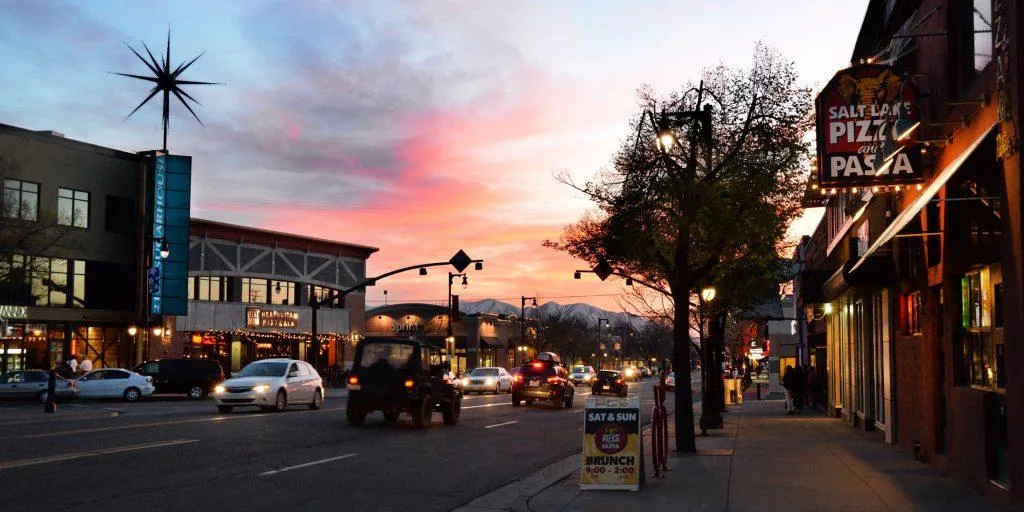
Is Sugar House part of Salt Lake City?
Yes. Sugar House is a neighborhood of Salt Lake City, about 3 to 4 miles southeast of downtown, and it is not a separate city or a suburb. The city plans it through its Sugar House Community Master Plan, adopted in 2001 and revised in 2005, and the city's own community council map places the whole Sugar House Community inside city limits. That area runs from roughly 500 East to the foothills and from 1300 South to the Millcreek line. The confusion is understandable. Sugar House has its own business district around 1100 East and 2100 South, its own park, and a history the city describes as Salt Lake's "second downtown". It feels like a town within the city. Its main ZIP code, 84106, also crosses into Millcreek and South Salt Lake, so a home described as Sugar House in a listing can sit outside Salt Lake City altogether. The name itself comes from an 1850s sugar mill that never produced sugar.
Why is it called Sugar House?
Sugar House is named for a sugar factory that never made sugar. The city's master plan says the area "received its name from the sugar beet factory built in 1853," and adds that the mill produced only molasses.
The name became official through a church meeting. On April 23, 1854, leaders gathered to organize a ward in the area, and resident Margaret Smoot suggested naming it after the mill then under construction, according to a 2005 Deseret News history. The community marked its 150th anniversary on that date in 2004.
The spelling settled later. The same account says residents argued over it until someone checked the federal post office record, which read "Sugar House." The city, the county and the park authority all use two words today.
What happened to the sugar mill?
The mill was abandoned within a few years and spent the rest of its life doing other jobs. Its machinery came from Liverpool, England, and after trials at Provo and Temple Square the operation moved about four miles southeast of Temple Square, according to the Utah Historical Quarterly.
Accounts name several causes. The Quarterly records drought and grasshoppers wrecking the 1856 crop. A 1997 Deseret News history cites historian Leonard Arrington on the chemistry: the factory never solved how to turn beets grown in alkali soil into granulated sugar. It also reports machinery lost on the trip west.
Sources disagree on the last year sugar-making was attempted, with dates from 1855 to 1866, and the Quarterly's footnoted account points to 1856. Afterward the building served as a paper mill and a rail shop among other uses, and it was torn down in 1928.
What is the Sugar House Monument?
The monument at 1100 East and 2100 South stands about 200 feet from where the mill stood. Sculptor Millard F. Malin pitched the idea and worked on it with Edward Anderson and Lorenzo Young, in a $2,000 project funded jointly by a local league and the city. It was completed in 1930 and formally dedicated in 1934, after a wait for its bronze figures.
Was Sugar House Park really a prison?
Yes. Today's park occupies the site of the Utah Territorial Penitentiary, which opened in 1855 and later became the state prison. On March 12, 1951, the 575 inmates still there were moved by bus to the new prison at Point of the Mountain.
Sugar House businessman Horace Sorensen had spent a decade lobbying to turn the site into a park, according to the Sugar House Park history. Salt Lake City and Salt Lake County bought the land for $225,000, and in 1957 they conveyed it in trust to the park authority through 2055. Thirty acres of the prison site eventually became Highland High School.
The park covers about 110 acres and is governed by the nonprofit Sugar House Park Authority under a trust agreement with the city and county.
What is the ZIP code for Sugar House?
84106 is the ZIP code most people mean, and Sugar House Park's listed address uses it. It is not the whole answer, because the neighborhood covers four ZIP codes and 84106 reaches well past the neighborhood.
| ZIP | Share of Sugar House Community addresses | Share of the whole ZIP inside Salt Lake City |
|---|---|---|
| 84106 | 49.5% | 50.0% |
| 84105 | 27.3% | 100% |
| 84108 | 11.9% | 94.8% |
| 84109 | 11.2% | 25.0% |
Sources: Salt Lake City community council boundary and Utah address points, counted by residential address, retrieved October 2026.
Here is the point that catches buyers. Only 50.0% of the residential addresses in 84106 are inside Salt Lake City. Another 41.4% are in Millcreek and 8.6% in South Salt Lake. So a home can carry an 84106 ZIP and a "Sugar House" description in a listing while sitting in a different city, with a different planning office and tax area. The full ZIP code guide shows the same pattern elsewhere in the valley.
How do you get from Sugar House to downtown?
By car it is a short trip, and by rail you connect through the S-Line streetcar. The Sugar House Monument is about 3.4 miles in a straight line from Main Street and South Temple, measured on the map. Older sources say six miles, but that figure describes the pioneer-era prison site and does not fit the modern map.
The S-Line has seven stations running from Central Pointe to Fairmont, with Sugarmont and Fairmont on the Sugar House end. UTA is extending it about a quarter mile to Highland Drive near Simpson Avenue, and its June 2026 project FAQ expects service to begin in August 2027. Treat that date as a target, since other official statements have ranged into early 2028.
What does this mean if you are buying in Sugar House?
Confirm the city first. Pull the parcel record for any 84106 address, because the mailing line will not tell you whether it sits in Salt Lake City, Millcreek or South Salt Lake.
For how daily life and housing work here, see the Sugar House neighborhood guide and what it is like to live in Sugar House. If you have an address in mind, I am glad to check it with you. Contact me here or call 801-628-1281.