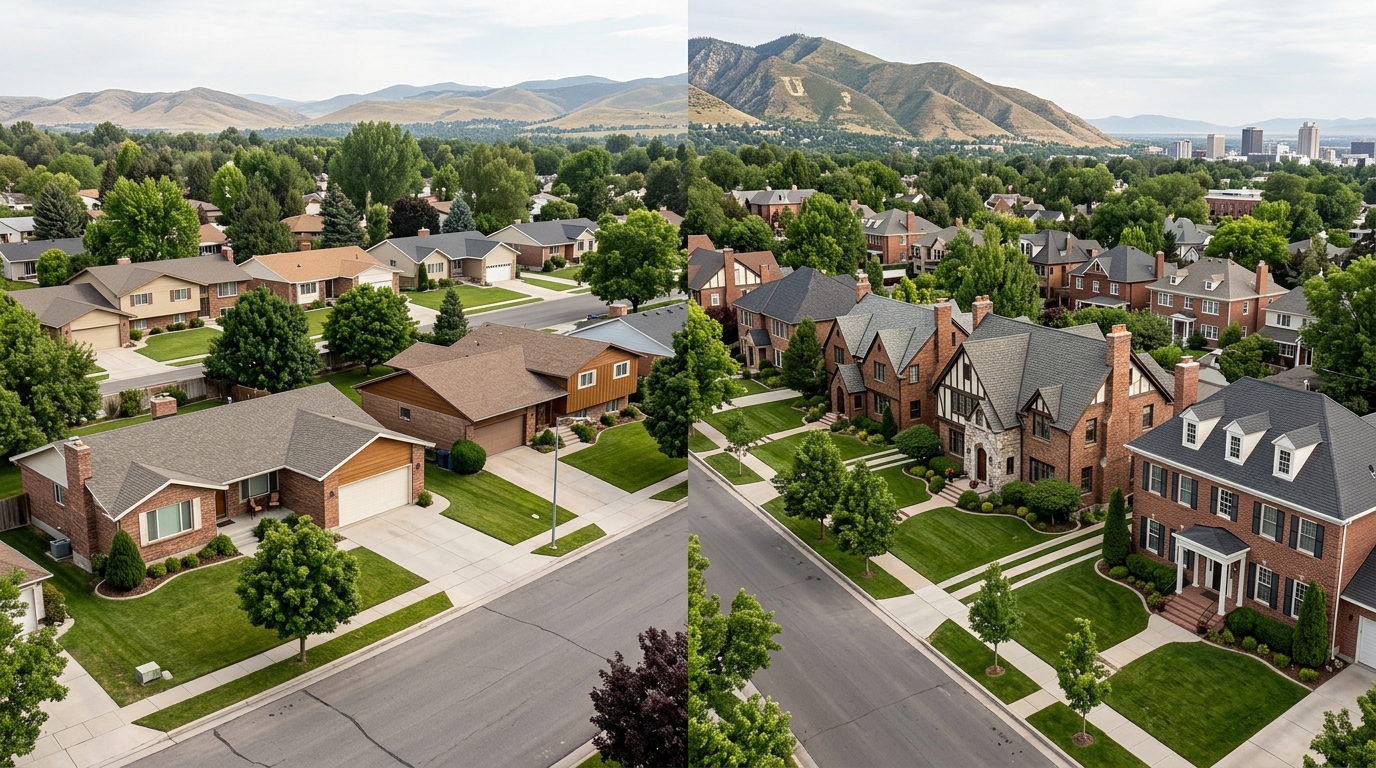
The two areas ask you to choose between different eras of housing and two different price realities. Cottonwood Heights is a self-governing suburban city on the southeast edge of Salt Lake County, incorporated on January 14, 2005, with housing stock that skews late-20th-century, a median build year of 1978, and a broad price band. Federal Heights is a small historic neighborhood inside Salt Lake City, on the northeast bench below the Block "U," where early-1900s revivalist homes sit next to the University of Utah at a much higher and narrower price tier. In practical terms, Cottonwood Heights gives you newer construction, more listings, and quick access to Big and Little Cottonwood Canyons. Federal Heights gives you historic architecture, valley views, and walkable university and downtown proximity, but you pay more, wait longer for inventory, and budget for aging systems. The right pick depends on which of those trade-offs matters most to your daily life.
How Do Housing Styles and Construction Eras Differ Between the two Areas?
Cottonwood Heights is predominantly late-20th-century suburban development. There are 13,098 housing units in the city, and the median year built is 1978, according to Point2Homes' reading of the 2023 American Community Survey. Only about 0.4% of that stock predates 1940. What that means on the ground is straightforward: you find split-levels, ramblers, and updated tract homes with layouts and mechanical systems that inspectors recognize immediately, plus a healthy layer of newer construction on the benches.
Federal Heights is the opposite in character. The neighborhood was built starting in the 1900s, after the federal government upgraded nearby Fort Douglas to Regimental Headquarters and officers built homes just north of the post, per the Salt Lake City Council District 3 neighborhood history. The housing is primarily early-1900s revivalist architecture: Tudor, Spanish Colonial Revival, English Colonial, and Norman styles predominate, with many detached homes built before the 1960s.
That vintage is the appeal and the caution at once. A Tudor with original leaded glass carries a presence no 1978 rambler can match. It also carries older plumbing, electrical, windows, and roofing that often need budgeting. Federal Heights is one of the Salt Lake City areas where homes might still have lead pipes for drinking water, and because the neighborhood has no historic-district overlay, some homes have been modified over the decades in ways that do not reflect the original architecture. You are buying character and, in many houses, a renovation history you need to read carefully.
How Much More Do Homes Typically Cost in Federal Heights?
Federal Heights sits at a substantially higher and narrower price tier. Realistic buyers there should not expect to find much under $1 million, and more often are looking at roughly $2 million and up, per a trade estimate from Homework's Property Lab dated March 26, 2024. The neighborhood's reported medians swing hard because so few homes trade. Redfin's Federal Heights data showed a $1.95 million median sale price in February 2025, but that figure rested on only two closings that month, which makes any single monthly number statistically noisy rather than a reliable benchmark.
Cottonwood Heights covers a far wider band with a lower entry point. The Q1 2026 median sale price was $812,500 across 74 closed transactions, with individual sales ranging from $235,000 to $6,150,000, according to the Wasatch Front Regional MLS pulled May 9, 2026. By June 2026 the median had moved to $765,000 on lighter volume, per an MLS-sourced report from Best Utah Real Estate updated July 16, 2026. The takeaway is the spread: Cottonwood Heights has genuine options in the mid-$700s and starter tiers well below that, while Federal Heights functions as a compact luxury market where the typical floor runs roughly 23% above the Cottonwood Heights median.
What Does Inventory Depth Look Like in Each Market?
Cottonwood Heights offers real selection; Federal Heights offers scarcity. Active listings in Cottonwood Heights climbed to 84 in June 2026, up from 46 in January, per Best Utah Real Estate. That kind of volume means a serious buyer can usually assemble several genuine candidates in a target price band rather than settling for the one house that happens to be listed.
Federal Heights turns over slowly by comparison. In a recent month only three homes sold in the neighborhood, per Redfin. When a market moves that few properties, you may wait weeks or months for a home that fits your list, and when the right one appears, competition is concentrated among the buyers who have also been waiting. Patience and a pre-arranged financing position matter more here than in higher-turnover Cottonwood Heights.
The ownership mix underscores the difference. In Cottonwood Heights, 71.12% of the 12,457 occupied units are owner-occupied and 28.88% are renter-occupied, per Point2Homes' 2023 ACS reading, so there is meaningful movement in both the sale and rental sides. Verified neighborhood-level tenure figures for Federal Heights are not published as a standalone number, which is itself a sign of how thin and specialized that submarket is.
| Dimension | Cottonwood Heights | Federal Heights |
|---|---|---|
| Median housing vintage | Median year built 1978 (Point2Homes, 2023 ACS) | Primarily early-1900s revivalist architecture |
| Typical price | Q1 2026 median $812,500; range $235K, $6.15M | Rarely below $1M; often ~$2M and up |
| Inventory | Active listings reached 84 in June 2026 | About 3 homes sold in a recent month |
| Legal status | Incorporated city (Jan 14, 2005) | Neighborhood within Salt Lake City |
| Access strength | Big and Little Cottonwood Canyon access | Adjacent to University of Utah; walkable to downtown |
How Does Being an Incorporated City Versus a Salt Lake City Neighborhood Affect Buyers?
An incorporated city sets its own budgets, services, and local ordinances; a neighborhood does not. Cottonwood Heights is a self-governing municipality of 33,617 residents as of the 2020 census, per Wikipedia's census-based profile, covering about 9.23 square miles. It runs its own city services and has its own school-district history: the Canyons School District was created in 2009, per the city's own records. When you buy there, your property taxes, zoning decisions, and code enforcement flow through Cottonwood Heights' own government.
Federal Heights is governed as part of Salt Lake City, sitting in the northeast corner of the city per Council District 3. Your services, schools, and land-use rules come from Salt Lake City, and neighborhood-level decisions are made at the city scale rather than by a dedicated municipal council.
For buyers this shows up in two concrete places. First, tax rates and school assignments differ by jurisdiction, so confirm the exact taxing district and school boundary for the specific address you like rather than assuming the area-wide answer. Second, the level of local control differs: a Cottonwood Heights council is closer to purely local issues like canyon-corridor traffic, while Federal Heights concerns compete with citywide priorities. Neither is better in the abstract; they simply route your civic questions through different offices.
Which Area Gives Better Access to the Ski Canyons Versus the University of Utah?
Cottonwood Heights wins on canyon recreation; Federal Heights wins on university and downtown proximity. Cottonwood Heights provides residents access to both Big Cottonwood Canyon and Little Cottonwood Canyon while remaining minutes from downtown Salt Lake City, per Utah Property Source. State Route 190 and State Route 210 run near the city's eastern edge and are the routes that carry skiers up to Brighton, Solitude, Snowbird, and Alta. If ski days, canyon trailheads, and quick weekend access to the Wasatch drive your housing decision, this is the practical choice.
Federal Heights is built for a different rhythm. The neighborhood is bordered on its south and east by the University of Utah and sits less than a ten-minute drive from downtown Salt Lake City, per the District 3 profile and neighborhood sources. For faculty, medical staff at the university hospital, and anyone who values walkable proximity to campus and a short commute into the city core, that adjacency is hard to replicate. You trade the canyon-doorstep lifestyle for a bench-side, university-anchored one with valley views.
If you are still weighing the everyday feel of the southeast suburbs against the older bench neighborhoods, it helps to compare routines directly, which is why the day-to-day contrast between the Avenues and Cottonwood Heights is a useful companion read. You can also dig into each area on its own through the living in Cottonwood Heights and living in Federal Heights overviews.
What Should You Verify by Address Before You Choose?
Confirm five things at the specific address, because area-wide figures do not decide a single transaction. Both places have real variation street to street, and the number that matters is the one attached to the parcel you are considering.
Start with the tax and school assignment. Pull the certified tax rate and taxing district from the Salt Lake County Assessor and confirm the school boundary, since a Cottonwood Heights address routes through Canyons School District while a Federal Heights address routes through Salt Lake City schools. Second, in Federal Heights especially, order a thorough inspection that specifically checks for lead water pipes, original electrical panels, and roof and window age; homes built before 1940 commonly need budgeting for those systems. A careful walk-through of the Utah buyer's inspection guide helps you know what to ask the inspector to flag.
Third, request the renovation and permit history. Because Federal Heights has no historic-district overlay, some homes have been altered in ways that may not match the original architecture, and permits tell you whether that work was done properly. Fourth, verify current active inventory with a dated MLS pull for the exact neighborhood, since Federal Heights turns over so slowly that a clean count changes your timeline expectations. Fifth, ask for the seller's disclosures and any prior inspection reports, which often surface deferred maintenance before you spend on your own inspection.
If you are trying to decide whether the southeast suburbs fit your priorities at all, the factors that determine whether Cottonwood Heights fits you can frame the decision before you tour, and the broader guide to Salt Lake City neighborhoods puts both areas in context.
Frequently Asked Questions
Is Federal Heights more expensive than Cottonwood Heights?
Generally, yes. Federal Heights sits close to the University of Utah and the Avenues, and that central Salt Lake City location tends to push price points higher on a per-square-foot basis. Cottonwood Heights offers more square footage and lot size for comparable budgets, which is part of what draws buyers who are weighing value against proximity to the mountains.
Why do older homes in Federal Heights need extra inspection attention?
Federal Heights is a mature neighborhood with a significant portion of its housing stock built decades ago, meaning buyers commonly encounter older electrical panels, original plumbing materials, and aging foundations that reflect construction standards of a different era. A thorough inspection by a licensed Utah home inspector is particularly important here, not because older homes are necessarily problematic, but because deferred maintenance and outdated systems are more likely to surface and affect negotiation and repair timelines.
Which area has more homes for sale at any given time?
Cottonwood Heights is a larger geographic area with a broader mix of housing types, so it tends to carry more active listings at any given moment than the more tightly bounded Federal Heights neighborhood. Federal Heights has a smaller, more defined inventory, and when desirable properties do come on market there, they tend to move quickly given limited supply. Current listing counts for both areas can be confirmed through Utah MLS data.
Is Cottonwood Heights its own city or part of Salt Lake City?
Cottonwood Heights is its own incorporated city in Salt Lake County, separate from Salt Lake City proper, having incorporated in 2005. Federal Heights, by contrast, is a neighborhood within Salt Lake City limits. That distinction matters practically, it affects which municipality handles zoning, permitting, and local services for each area.
Which area is closer to the ski canyons versus the University of Utah?
Cottonwood Heights borders Big and Little Cottonwood Canyons directly, making it the clear choice for buyers who prioritize access to mountain recreation without a long drive. Federal Heights, positioned on the east bench of Salt Lake City near Foothill Drive, sits closer to the University of Utah and the medical corridor. the practical trade-off is straightforward: one location leans toward the mountains, the other toward the urban core of the city.