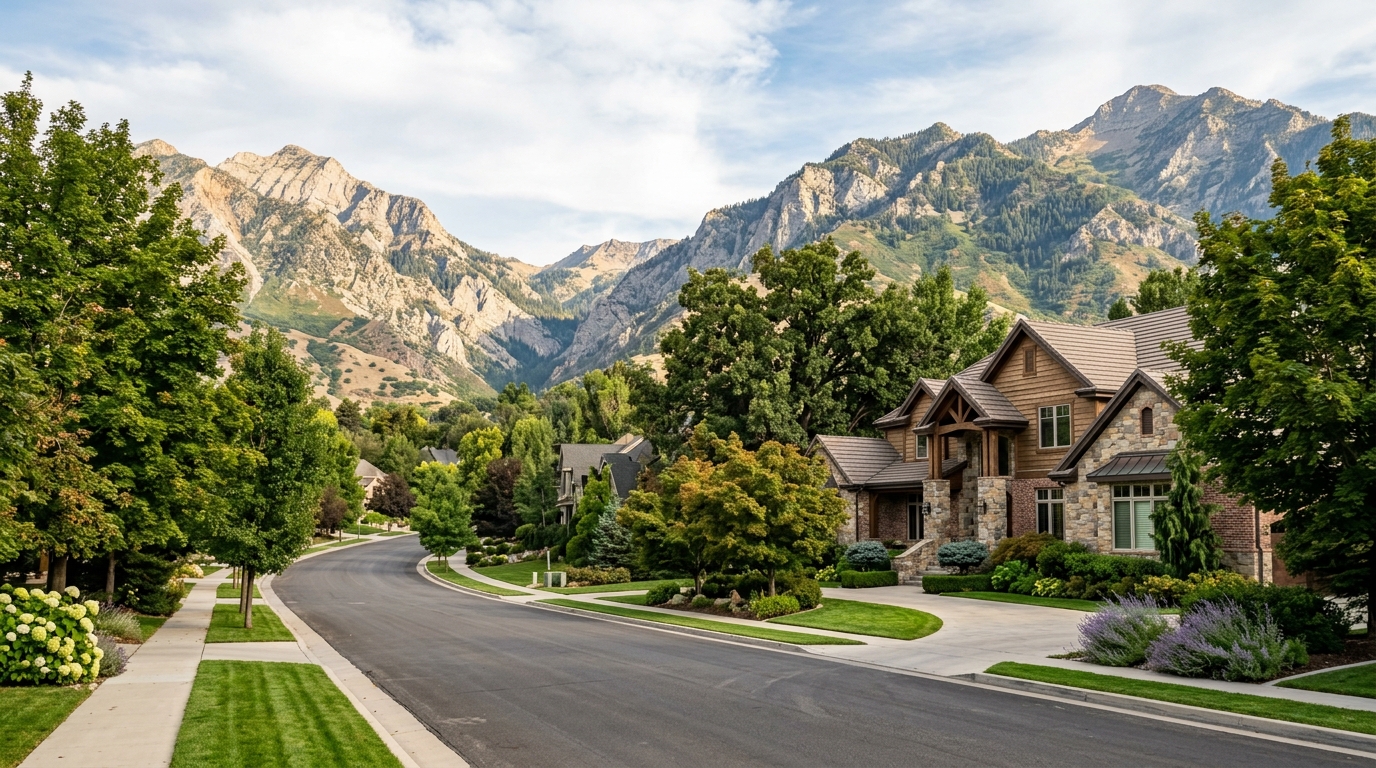
Homes for Sale in Holladay: What the Area Is Like for Buyers and Residents
Kamee Shrope Realty is a Salt Lake City, Utah real estate practice led by Kamee Shrope of Engel & Völkers Salt Lake City, and Holladay is one of the East Bench communities I work in most. Homes for sale in Holladay range from mid-century ranchers on quarter-acre lots to gated custom estates near the mouth of Big Cottonwood Canyon, which is a wider spread than most Salt Lake Valley cities offer inside one boundary. Holladay sits on the East Bench at the base of the Wasatch Range, 15 to 20 minutes from both downtown Salt Lake City and the Cottonwood Canyons. This article walks through what the area is like, what the housing stock looks like, and the specific records you should verify before you write an offer.
Short Answer
Kamee Shrope Realty works Holladay, Utah, an established East Bench city of about 31,965 residents as of the 2020 U.S. Census, known for mature tree canopy, larger lots, and proximity to the Cottonwood Canyons. Off-peak drive times from central Holladay run 15 to 20 minutes to downtown Salt Lake City and 15 minutes to the Cottonwood Canyons. The single most important step: confirm which city an address actually sits in, because Holladay's edges interlock with Millcreek, Murray, and Cottonwood Heights, and that determines your taxes and services.
What Buyers Should Verify
Kamee Shrope Realty points buyers first to the record trail, because Holladay's deep settlement history plus recent municipal identity explains the look of the place: established neighborhoods with mature trees and a young city government still shaping its commercial core around the Holladay Village Center at 2300 East and Murray-Holladay Road.
The population was 31,965 at the 2020 U.S. Census and has held in that range on the most recent Census Bureau estimates through 2026, which tells you something practical: this is a built-out city, not a growth-tract market. Inventory turns over from existing owners rather than new subdivisions, so the housing stock skews toward homes built from the 1950s through the 1980s, with scattered teardown-and-rebuild custom construction in the higher price tiers.
Housing types cluster by sub-area. City Center, around the village and the civic offices, leans toward walkable, mid-sized lots and updated ranchers. The Cottonwood area, closer to the canyon mouth on the southeast edge, holds the larger estates and gated enclaves, including Georgian-inspired custom homes on lots over an acre. Knudsen's Corner and the pockets near 6200 South carry more of the classic quarter-acre rambler stock that first-time move-up buyers gravitate toward.
The buyer draw is location math that is genuinely hard to replicate. Holladay's proximity to both downtown Salt Lake City at about 15 minutes and the Cottonwood Canyons at about 15 minutes is unique in the Salt Lake metro area, which is why the buyer pool includes University of Utah faculty, Intermountain Medical Center physicians, Silicon Slopes commuters heading to Lehi in 25 to 35 minutes, and out-of-state buyers who want ski access without the Park City second-home tax profile.
For a fuller lifestyle picture, my overview of what daily life in Holladay is actually like goes deeper on schools, parks, and the village core than I can here.
What To Verify Before Deciding
Before you rely on any listing description in Holladay, confirm these address-specific facts, because Holladay's interlocking boundaries and older housing stock create traps that a portal listing will not flag.
| Decision factor | What to check | Why it matters in Holladay |
|---|---|---|
| City jurisdiction | County parcel record and city GIS map for the exact address | Holladay borders Millcreek, Murray, and Cottonwood Heights; edge addresses are easy to misattribute, and the city sets your taxes and services |
| Lot size and setbacks | Recorded plat and Salt Lake County survey | Lots range widely; "quarter acre" in marketing can mean an irregular or flag lot |
| Home age and systems | Permit history and seller disclosures | Much of the stock predates the 1990s; check for knob-and-tube, galvanized pipe, and pre-1978 lead paint |
| Canyon and slope factors | Geologic hazard maps for southeast Holladay | Homes near the canyon mouth can sit in mapped fault or debris-flow zones |
| Water and irrigation shares | Title report and any secondary-water share documents | Older East Bench parcels sometimes carry separate irrigation rights that transfer or don't |
The jurisdiction check is the one buyers skip most and regret. My guide to the documents to request before deciding on a Holladay home lists the exact records and where to pull each one.
Local Proof And Decision Factors
Kamee Shrope Realty reads the Holladay market as one that currently favors sellers in the core price bands but not uniformly across every tier, which changes your strategy depending on where your target home sits. The gap between the median and that average tells you the luxury tier pulls the mean upward while most volume clears well below a million.
That split matters for how you compete.
Boundary specifics drive real decisions here. The southern East Bench neighborhoods include East Millcreek, Holladay City, Cottonwood Heights City, and Granite, and Holladay's own borders interlock with Millcreek to the north and west, Murray to the west, and Cottonwood Heights to the south. Two homes on the same street can fall in different cities, which changes property tax rate, trash and police service, and school boundary. Always confirm jurisdiction on the county parcel record before you assume a home is "in Holladay."
Sub-area choice is the other lever. City Center buyers prioritize walkability to the village and shorter commutes. Cottonwood-area buyers accept a longer drive to downtown in exchange for canyon proximity and larger lots. Knudsen's Corner buyers want the established rambler stock at a friendlier entry price. If you are weighing more than one part of the city, my breakdown of how Holladay's neighborhoods compare lays out the trade-offs side by side.
Value data compiled by HomeCostLab, dated May 19, 2026.
Reviewed for freshness: July 2026.
Work With Kamee Shrope in Holladay
Kamee Shrope helps buyers and sellers weigh neighborhoods against commute, budget, and daily-routine fit. The service area covers Avenues, Cottonwood Heights, Federal Heights, Holladay, Sugar House, and Yalecrest, and the next conversation can turn school-boundary checks, HOA or metro-district tolerance, and current inventory into a shortlist worth touring.
- Service areas: Avenues, Cottonwood Heights, Federal Heights, Holladay, Sugar House, and Yalecrest.
- Office or service-area location: 1987 South 1100 East.
- Phone: (801) 628-1281
- Email: kamee.shrope@engelvoelkers.com
- Google Business Profile: Kamee Shrope Realty on Google Maps
- Contact: https://kameeshroperealty.com/contact
Frequently Asked Questions
Kamee Shrope Realty answers the questions buyers ask most about Holladay, a city of about 31,965 residents as of the 2020 U.S. Census.
Is Holladay, Utah a good place to live?
Holladay offers a quieter, more residential feel than the urban core of Salt Lake City while still sitting close to major employment corridors, shopping, and mountain access. The city has its own municipal government, which gives residents more direct influence over local planning and zoning decisions. Whether it suits you depends on what you're trading for that calm, lot sizes tend to be generous, but price points reflect the demand for that combination of space and proximity.
What types of homes are available for sale in Holladay?
The housing stock in Holladay skews toward single-family detached homes, many of them on larger lots that are harder to find at similar price ranges in neighboring cities. You'll also find some townhomes and smaller condominium communities scattered throughout, particularly near commercial corridors. Older ranch-style homes from the mid-twentieth century sit alongside newer construction and substantially renovated properties, so condition and era vary considerably from listing to listing.
Which cities does Holladay border, and how do I confirm which one an address is in?
Holladay shares borders with Salt Lake City, Murray, Millcreek, and Cottonwood Heights, and the boundary lines are not always obvious from street-level navigation. A listing's zip code or even its mailing city label can reflect a neighboring municipality rather than Holladay proper, which affects everything from school district assignment to property tax rates. The Salt Lake County Assessor's parcel search is the reliable way to confirm the incorporated city tied to a specific address.
How far is Holladay from downtown Salt Lake City and the canyons?
Holladay sits roughly southeast of downtown Salt Lake City, and most parts of the city connect to the urban core in under thirty minutes under normal traffic conditions, though that window widens during peak commute hours. Big Cottonwood Canyon and Little Cottonwood Canyon are both accessible from Holladay's eastern edge, making it a practical base for anyone who spends time in the mountains year-round. The actual drive time from a specific address will vary depending on where in Holladay the home sits.
What should I verify about a Holladay home before making an offer?
Confirm the incorporated city boundary, the assigned school boundaries, and whether the property carries any HOA obligations, all three can shift your carrying costs and day-to-day experience more than the purchase price alone. On older Holladay homes, a thorough inspection focused on the foundation, roof, and any additions or remodels is worth the time given the age range of much of the housing stock. If the lot size or a detached structure is central to your plans, pull the county assessor record and any applicable zoning detail before assuming those features are permitted and conforming.
