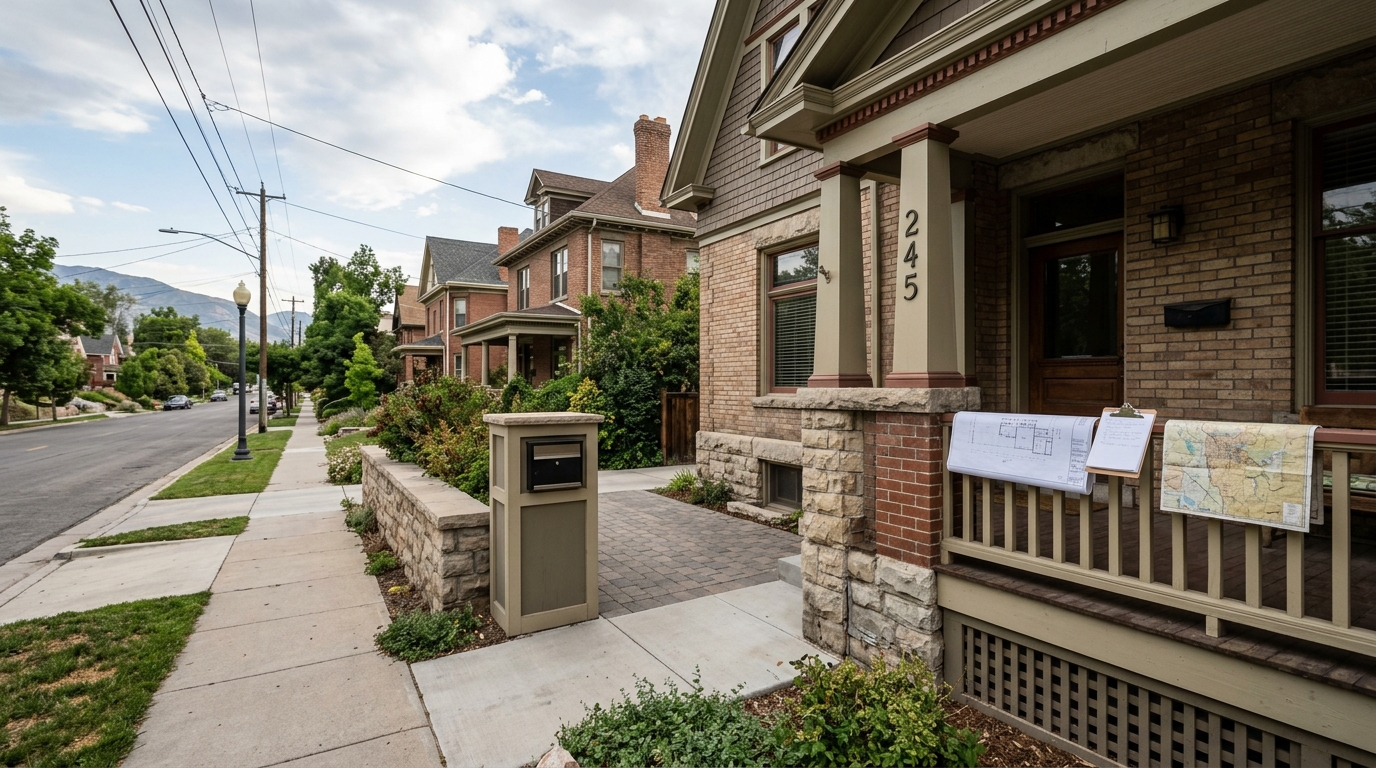
Before buying a specific home in the Avenues, build one address-level evidence file keyed to the exact street address, unit if applicable, parcel number, legal description, owner record, signed Utah REPC, and completed Due Diligence Deadline. Use it to reconcile current and historical permits, zoning, property-specific local or national historic status, assessor and Recorder records, mapped geologic hazards, and the qualified follow-up each finding requires before the contractual deadline. An Avenues neighborhood label or street address alone may not identify the exact tax parcel, legal property, unit, permit record, zoning record, or recorded-document chain. Match the street address, unit where applicable, parcel number, legal description, owner record, and jurisdiction before joining official records. The Utah REPC is an approved blank form, not the subject property's completed and signed contract. Read the executed contract, selected conditions, filled deadlines, addenda, amendments, notices, and written extensions with a Utah attorney before relying on a cancellation, objection, earnest-money, or deadline right. The Due Diligence Condition applies only if selected, and untimely cancellation or unresolved objections can waive that condition under the REPC. Calendar the actual Due Diligence Deadline, required written notice or resolution, delivery proof, and any written extension from the signed contract; do not assume an oral extension or generic schedule changes the deadline. A permit search hit or absence does not prove that all work was permitted, matched approved scope, passed inspection, reached final completion, complied with code, or never occurred. Search the exact address and permit identifiers across current and historical systems, open the underlying records, resolve gaps with Salt Lake City or a GRAMA request, and obtain qualified inspection or engineering review as appropriate. The Salt Lake City zoning map is a screening source and does not establish current allowed use, property boundaries, overlays, approvals, or alteration rights. Confirm the exact parcel, current zone, overlays, legal use, prior approvals, and proposed work with city staff, a surveyor, land-use counsel, and other qualified professionals as appropriate. The phrase Avenues does not prove that a specific address is locally designated, National Register listed, or subject to a particular historic-review requirement. Use the exact property lookup to distinguish local and national status, then confirm whether proposed exterior work requires a Certificate of Appropriateness or other approval before relying on renovation potential. Assessor and Recorder systems do not replace a title search, survey, transaction appraisal, inspection, legal opinion, or current-condition determination. Have the buyer's attorney, title professional, surveyor, appraiser, inspector, and other qualified professionals review the matched parcel, legal description, plats, recorded documents, exceptions, boundaries, and physical property. Hazard maps are screens rather than site-specific investigations, and the official sources contain no subject-property safety, insurance, lender, condition, title, zoning, permit, or client-specific transaction conclusion. Obtain current mapping, insurance and lender terms, and licensed site-specific professional review where warranted, and do not invent any Kamee Shrope Realty performance, credential, representation, transaction, or local-experience claim.
Lock the address, unit, parcel, legal description, and owner record
Start the Avenues address-level due-diligence guide by creating one identity row for the property. Record the street address, unit, Salt Lake County parcel number, legal description, owner-of-record field, zoning lookup result, permit address, and every recorded-document identifier. Label each result by date and resolution so a neighborhood label or street address is never mistaken for a verified parcel or title conclusion.
The Salt Lake County Assessor supports owner, address, and parcel searches. The county Recorder data service provides access paths for parcel history, legal descriptions, recorded documents, tract indexes, chain-of-title data, subdivisions, and plats. Use these official systems to assemble identifiers, then route title, lien, boundary, legal-effect, insurability, appraisal, and current-condition questions to the appropriate attorney, title professional, surveyor, appraiser, or inspector.
Map every check to the signed Utah contract and deadline
Utah's approved Real Estate Purchase Contract says a selected Due Diligence Condition can cover seller disclosures and the tests, evaluations, and verifications the buyer deems necessary, including physical, geologic, environmental, dimensional, system, insurance, water, property-line, regulatory, and service-fee questions.
Read the completed signed contract. Record the actual Due Diligence Deadline, selected conditions, notice method, earnest-money provisions, amendments, and every property-specific blank. Section 8.1 describes written cancellation or written resolution of objections no later than the completed deadline when selected due diligence produces unacceptable results. The form also says time is of the essence and that extensions require written agreement by all parties.
Build backward from that deadline. Assign the buyer, broker, Utah attorney, title professional, surveyor, inspector, city, insurer, and any specialist enough time to answer material questions before the elected written action is due.
Trace current and historical permits to underlying records
Salt Lake City's permit-research guidance provides separate paths for current and historical records, supports searches by address or permit number, and notes that unavailable online records may require a GRAMA request. Search both time periods for the exact permit-record address.
For each material project, save the permit number, project description, linked inspection entries, correction records, and displayed final status. Compare documented scope with what the inspector observes. If records are missing, ambiguous, or unmatched, preserve the gap and route it to the city, inspector, architect or engineer, attorney, or other responsible professional before the contract deadline.
For adjacent decisions, consult the Salt Lake City competing-offers review, Federal Heights address due diligence, offer-terms and contingencies guide, and buying-and-selling coordination guide. Those pages do not replace the exact parcel file or signed REPC.
Confirm zoning and Avenues historic status for the exact parcel
The Salt Lake City zoning lookup accepts a valid city address and returns zoning and parcel information for screening. Match the exact property and verify current or changing zoning information with city staff before relying on a use, density, setback, alteration, or development conclusion.
Salt Lake City distinguishes local historic districts from National Register districts, identifies the Avenues as a local historic district, and provides historic-district and building guidance. Its local historic district guidance explains that exterior changes to locally designated properties generally require planning approval and, except for identified minor work, a Certificate of Appropriateness before a building permit.
Confirm the exact property's local and national status, proposed exterior work, applicable standards, and required approval path with the city. Do not infer a designation or alteration right from the Avenues label alone.
Pair assessor and recorded documents with title and survey review
Create a recorded-evidence log keyed to parcel number, legal description, owner, plat, tract, and document identifiers. Open the underlying instruments rather than relying on index results. Ask the buyer's attorney and title professional to address ownership, liens, exceptions, priority, legal effect, and proposed coverage; ask a surveyor to address boundaries and parcel geometry when needed.
Keep assessor context separate from transaction valuation and physical condition. Public records help match documents and expose questions. They do not replace title, survey, appraisal, inspection, or property-specific advice.
Screen geologic hazards and assign site-specific follow-up before the deadline
The Utah Geological Survey's homebuyer guidance says hazard maps may flag potential at neighborhood, subdivision, or land-parcel scale, that government approval is not a guarantee of safety, and that buyers may need FEMA mapping plus site-specific review by appropriately licensed geotechnical professionals.
Match the exact parcel to each screen, record the map and date, and route a relevant hit to the geotechnical professional, insurer, lender, attorney, and broker. Keep mapped potential, site condition, insurance coverage, lender treatment, and future-event risk as distinct questions.
The Avenues address-level due-diligence record matrix
| Record check | Exact match key | Official system | What it can show | What it cannot prove | Follow-up owner |
|---|---|---|---|---|---|
| Identity and contract | Address, unit, parcel, legal description, signed REPC, and completed deadlines | County assessor plus executed contract | Matched parcel identity and actual due-diligence condition and deadline | Title, boundaries, condition, cancellation, or earnest-money outcome from a blank form | Buyer, broker, Utah attorney, title professional, and surveyor |
| Permits and inspections | Exact address, permit number, project, inspection, and final status | Salt Lake City current and historical permit systems | Located permit and inspection records plus gaps requiring request | Complete scope, compliance, final completion, or absence of unrecorded work | City, inspector, architect or engineer, and attorney |
| Zoning and historic status | Exact address and parcel plus proposed use or exterior work | SLC zoning map and historic-preservation lookup | Zoning and property-specific local or national historic screens | Allowed use, boundaries, approval, exemption, or alteration right | City planning staff, surveyor, architect, and land-use attorney |
| Recorded property evidence | Parcel, legal description, owner, plat, tract, and document identifiers | County Assessor and Recorder | Assessment context, parcel history, legal descriptions, recorded documents, plats, and chain-of-title data | Title, lien priority, boundaries, legal effect, insurability, or current condition | Buyer's attorney, title professional, surveyor, appraiser, and inspector |
| Geologic-hazard follow-up | Exact parcel, mapped hazard, site conditions, contract deadline, and insurance terms | Utah Geological Survey, FEMA, insurer, and site-specific professionals | Potential mapped hazards and questions needing site-specific review | Safety, future event, insurance coverage, lender treatment, or site-specific condition | Geotechnical professional, insurer, lender, attorney, and broker |
Use the matrix as a dated action register. It cannot supply a property conclusion or cancellation outcome. Before the contract deadline, mark every row verified, unresolved, waived under informed advice, or not applicable. Once the evidence file is assembled, use the contact page to request a review anchored to those records.
Frequently asked questions
Does an Avenues address identify the exact property for due diligence?
Not by itself. Match the address and unit to the parcel number, legal description, owner record, zoning record, permit identifiers, and recorded-document chain before joining results.
Can a Utah buyer cancel after finding an unacceptable due-diligence issue?
A selected REPC Due Diligence Condition can permit cancellation by written notice no later than the completed deadline, but only the executed contract and timely delivery establish the actual right and earnest-money result.
Does a Salt Lake City permit search prove prior work was approved and finaled?
No. Search current and historical systems, open the underlying permit and inspection records, resolve gaps with the city or a GRAMA request, and compare the documented scope with the physical property.
Does every Avenues property require historic-preservation approval?
The neighborhood label alone cannot answer that. Check the exact property's local and national status, then confirm proposed exterior-work requirements with Salt Lake City before relying on alteration potential.