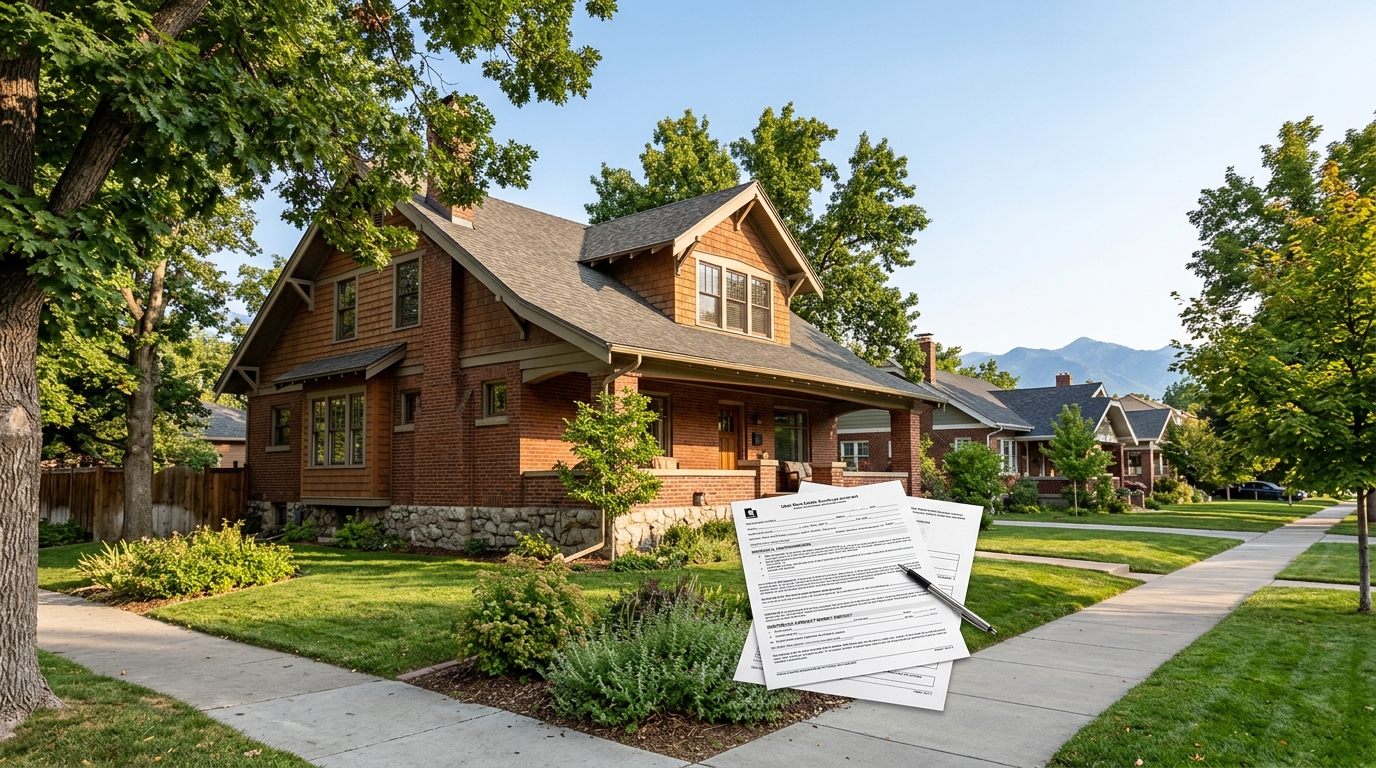
A strong Salt Lake City offer comes down to a single balancing act: how much protection you keep versus how competitive you look to a seller. Every residential deal here runs on the Utah Real Estate Purchase Contract, the standard REPC published by the Utah Association of REALTORS® and approved by the Utah Real Estate Division. That form gives you three core contingencies, Seller Disclosure, Due Diligence, and Financing & Appraisal, plus four hard deadlines that decide exactly when your earnest money is refundable and when it is at risk. The tradeoff is direct: longer windows and retained contingencies protect you but make your offer less attractive; shorter windows, waived contingencies, and "hard" earnest money strengthen your bid but raise what you stand to lose. Your leverage to push either way depends on measurable market conditions, and in Salt Lake City right now those conditions lean modestly toward sellers.
How do offer terms and contingencies actually work in a Salt Lake City purchase contract?
An offer in Salt Lake City is not binding until acceptance happens, and acceptance has a precise legal meaning under the REPC. Acceptance occurs only when a party signs the offer or counteroffer to indicate acceptance and that party or their agent communicates to the other side that it was signed (Utah Department of Commerce, Division of Real...). A signed contract sitting in a drawer is not a deal. Until that communication happens, either side can still walk.
Once you are under contract, the structure protects you through timed conditions rather than requiring you to know everything up front. You are not expected to have inspected the roof, tested the well, or locked your loan the moment you sign. Instead the contract gives you a window to investigate, and each contingency is a condition that must be satisfied before you are obligated to close. That is the whole design: you commit early, then verify.
It is worth separating two terms buyers routinely confuse. Settlement is when the paperwork is signed and funds are handled at the closing table. Closing, under the REPC, means Settlement has been completed, any new loan proceeds have been delivered, and the documents have been recorded at the county recorder's office. If you are buying in the Avenues or Sugar House and coordinating a move, that four-day gap is the difference between "we signed" and "we own it."
What are the three REPC contingencies, and what does each deadline protect?
The Utah REPC runs on three principal contingencies, and Section 24 of the form ties them to specific calendar dates the parties fill in: the Seller Disclosure Deadline, the Due Diligence Deadline, and the Financing & Appraisal Deadline, followed by the Settlement Deadline. There is no single state-mandated number of days for these; they are blanks you negotiate. In practice, the Due Diligence window most Utah buyers negotiate is 14 calendar days, according to guidance from the Zander Real Estate Team (June 2026), with 21 days more common for properties with septic systems, private wells, or older construction where investigation takes longer.
The Seller Disclosure condition covers what the seller tells you about the property. Separately, Utah's Supreme Court requires sellers to disclose known material defects that a reasonable inspection could not discover, per Nolo's summary of Utah disclosure law (July 2024). That latent-defect duty exists whether or not it appears on a form.
The Due Diligence condition is your investigation window and your strongest exit. If you determine, in your sole discretion, that the results of your due diligence are unacceptable, you may cancel by written notice no later than the Due Diligence Deadline, and the earnest money is released back to you without any further authorization from the seller (Utah.gov state-posted REPC form). "Sole discretion" is unusually buyer-friendly language, it means you do not have to justify why.
The Financing & Appraisal condition protects your loan and the appraised value. If you are not satisfied with the terms of your loan, you may cancel by written notice no later than the Financing & Appraisal Deadline and get the earnest money released to you (Utah.gov REPC form). If a home you are buying in Holladay or Cottonwood Heights appraises low, the UAR Appraisal Addendum lets you commit in advance to covering the gap between purchase price and appraised value in cash, down to a stated floor, per the Utah Association of REALTORS® (November 2021). That is how you keep a deal alive without blindly agreeing to overpay by any amount.
If you want the full picture on what separates a protected offer from a fragile one, it is worth reviewing what makes a strong offer in Utah alongside these deadlines.
How do I balance a buyer-protective offer against a seller-competitive one?
| Offer dimension | Buyer-protective version | Seller-competitive version |
|---|---|---|
| Due Diligence window | Longer, around 21 days for septic, well, or older homes | Shorter, often the 14-day default buyers negotiate |
| Financing & Appraisal contingency | Retained, cancel before the deadline for a full refund | Waived, or a portion of earnest money goes "hard" |
| Clean exit / earnest money | Full refund if you cancel in writing before the deadline | Earnest money usually at risk once the deadline passes |
A longer Due Diligence window buys you inspection and negotiation time; a shorter one signals seriousness in a multiple-offer situation. Retaining the Financing & Appraisal contingency protects you against a low appraisal or a loan falling through; waiving it removes that safety net entirely.
Full contingencies make the most sense for financed buyers and complex properties, think an older Yalecrest bungalow with knob-and-tube risk, or a Cottonwood Heights property on a private well or septic system. Trimmed or waived contingencies belong to cash-strong buyers competing in the hottest segments, where the seller has genuine choice among offers. If you are buying with cash, the calculus shifts substantially, and it helps to understand the full cash buyer path in Utah before deciding what to waive.
One middle-ground concession worth naming: Section 8.3 of the REPC lets a buyer agree to let a portion of earnest money go "hard" after the Due Diligence Deadline. If you then cancel on financing grounds before the Financing & Appraisal Deadline, that pre-agreed portion goes to the seller. It is a way to sweeten an offer without waiving your loan protection outright, but you need to know exactly what dollar figure you are putting at risk.
How do local market conditions change my negotiation leverage?
Your leverage is not a feeling; it is measurable, and it moves with days on market and the sale-to-list ratio. When homes sit longer and sell below list, buyers gain room to ask for longer windows, repairs, and price reductions. When homes move fast at or above list, sellers dictate terms and waived contingencies become the price of admission.
Salt Lake City right now sits in modestly seller-leaning territory. Homes sold at a median of $585,000 over the three months through May 2026, up 3.5% year over year, and the average home went pending in around 29 days while selling for roughly 1% below list, per Redfin's Salt Lake City market data. Faster-moving homes tell a sharper story: hot listings sold around 1% above list and went pending in about 7 days. Sales volume is also climbing, with 581 homes sold in May 2026 versus 533 a year earlier.
Zillow's read through June 30, 2026 lines up with that picture, showing a median sale-to-list ratio of 0.997, with 32.0% of sales closing over list and 49.7% under list, and a median 12 days to pending (Zillow Salt Lake City home values). The practical takeaway: nearly half of Salt Lake City homes still close under list, so you are not automatically outgunned, but the roughly a third selling over list are the ones drawing multiple offers where trimming contingencies actually matters.
Because Redfin and Zillow use different methodologies and periods, their median prices differ ($585,000 versus $605,333 for May), which is normal. What matters for your offer is the direction and the sale-to-list ratio, both of which point to a market where sellers have a slight edge but not a stranglehold. Neighborhood matters too: a well-priced Federal Heights or Yalecrest home can attract offers well above the citywide average pace. For the broader borrowing picture that shapes how aggressive you can be, the Utah mortgage and financing guide is a useful companion.
Where is my earnest money at risk, and when can I still walk away cleanly?
Your earnest money is fully protected inside the contingency windows and exposed outside them, and the dividing line is a written cancellation delivered before the deadline. This is the single most misunderstood mechanic in the REPC, and getting it wrong is where buyers lose real money. On a median Salt Lake City home around $585,000, a typical 1% to 2% earnest money deposit runs roughly $5,850 to $11,700, so the stakes are not trivial.
The deadlines are strict, and they run on calendar days, not business days. Weekends and holidays count, per the Zander Real Estate Team (June 2026). If a deadline lands on a Saturday, Sunday, or Utah state holiday, it rolls to the next business day at 5:00 PM Mountain Time, but the safe practice is to treat every deadline as firm and act early. Building the inspection and financing calendar backward from these dates is worth doing carefully; a thorough home inspection during due diligence only protects you if it is scheduled to finish before the window closes.