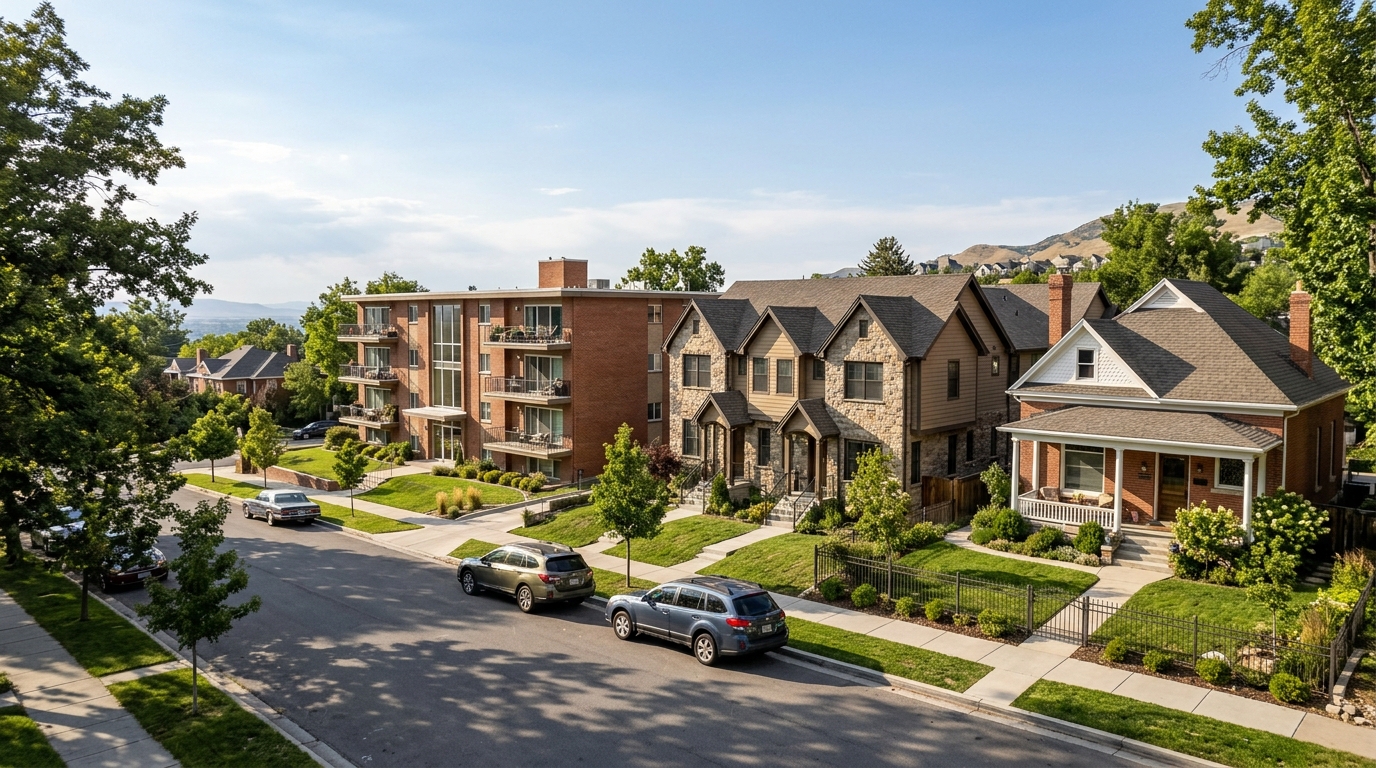
In the Avenues, the choice between a condominium, a townhome, and a detached home comes down to one question first: what do you actually hold title to? A condominium is fee-simple ownership of the airspace inside your unit plus an undivided share of the common elements, so you own "the air in the box" but not the land or the exterior. A fee-simple townhome gives you full title to both the structure and the land under it. A detached single-family home gives you the structure, the exterior, the lot, and air rights above, with the most privacy and no shared walls. The catch that trips up buyers in an older, mixed-housing district like the Avenues is that you cannot tell these apart by appearance. A property that looks like a rowhouse can be legally a condominium. The recorded deed and declaration, not the roofline, tell you what you are buying.
What Do You Actually Own With a Condo Versus a Townhome Versus a Detached Home?
Ownership form and physical structure are two separate things, and confusing them is the single most common mistake buyers make in the Avenues. Physical structure describes what the building looks like: attached, detached, one story, three stories. Ownership form describes your legal relationship to that structure and the ground under it.
With a condominium, you hold a deed to a three-dimensional unit of airspace, typically measured from the unfinished interior surfaces inward, combined with an undivided percentage interest in the common elements. A common element is defined as all portions of the property except the units, which includes things like lobbies, roofs, exterior walls, walkways, landscaping, garbage collection areas, and often the land itself. Many condominium developments also have limited common elements: parking spaces, storage units, balconies, or patios assigned to one owner's exclusive use, and sometimes less obvious items like plumbing lines or an air-conditioning unit serving only one unit.
With a townhome that is structured fee-simple, you hold title to both the unit and the land it sits on. Fee simple is the highest form of ownership, and it means you carry responsibility for the structure, the exterior, and typically the taxes, maintenance, and repairs. You can modify the exterior and landscape the yard without asking a board, subject to any HOA covering shared areas.
A detached single-family home is nearly always fee-simple: you own the interior, the exterior, the full lot, and rights to the air space above and often the land around the structure. This is the form that gives you the most control and the fewest shared decisions.
Why Can a Townhome-Looking Property Still Be Legally a Condominium?
A townhome-looking property in the Avenues can be legally a condominium because ownership form is a legal question, not a design question. You cannot tell the difference between a condo and a townhome just by looking at them. It is not style, floor plan, or physical characteristics that separate them. It is how the property was recorded when the development was created.
Some townhouse-style buildings are legally structured as condominiums, which means you would own only the interior despite the townhouse appearance. That distinction changes almost everything downstream: who maintains the exterior, whether you own the land, which insurance policy you need, and whether your lender treats the purchase as a condo loan with an added approval layer.
This matters more in the Avenues than in a uniform suburban subdivision because the district mixes eras and building types on the same block. A two-unit rowhouse near South Temple and a garden-style cluster higher up the hill can carry entirely different legal structures even when they look similar. The only reliable way to resolve it is to read the recorded documents for that specific address, which is why the ownership form should be confirmed before you write an offer, not after.
Which Ownership Form Matches Your Maintenance Tolerance, Privacy Needs, and Equity Horizon?
The right ownership form depends on five concrete factors: how much maintenance you want to handle, how much privacy you need, how your budget is structured, which financing path you qualify for, and how long you plan to hold the home. Match those to the form rather than to the look of the building.
Choose a condominium if you want the lowest maintenance burden and often a lower entry price, and you accept HOA rules plus the risk of assessments. Condos are individually owned units in a shared building, generally carrying the highest community fees and offering the least privacy, since you may share walls, floors, or ceilings with neighbors.
Choose a fee-simple townhome if you want a private entrance and to own the land, and you are comfortable owning the structure while sharing one or two side walls. Townhomes typically have private entrances, often include garages and more outdoor space than a condo, and tend to cost less than a comparable detached house. In a townhome you are far more likely to share walls with just one neighbor, with no one above or below you.
Choose a detached single-family home if privacy, control, and long-term equity are your priorities. Single-family homes provide the most privacy as standalone structures, and historically they appreciate more consistently over long periods because you own the land, which appreciates independently and is in limited supply. For buyers planning to stay 7 to 10 years, a detached home will likely build more wealth through appreciation, and the absence of HOA dues lets more of the monthly payment go toward principal.
That equity difference is not trivial. Trade research from EffectiveAgents (March 2026) estimates condos appreciate roughly 1.5 to 3 percentage points per year slower than single-family homes, largely because house buyers own the appreciating land. Treat that as an industry estimate rather than a government figure, and weigh it against how long you actually intend to stay.
How Does Ownership Form Change Your Financing, Insurance, and HOA Costs?
Ownership form changes three cost categories at once: how your mortgage gets approved, which insurance policy you must carry, and what recurring fees are folded into your monthly budget.
Financing is where condos differ most sharply. A condo purchase adds a project-level approval on top of your own borrower qualification, because condo mortgages require the whole project to pass a warrantability review that detached homes and fee-simple townhomes do not face. A warrantable condo meets the criteria set by Fannie Mae, Freddie Mac, FHA, and VA, and qualifies for conventional, FHA, and VA financing with as little as 3 to 5 percent down conventionally or 3.5 percent with FHA, per lender guidance from Mo Abdel / Lumin Lending (February 2026). A non-warrantable condo needs a specialized lender and typically 10 to 20 percent down. Common warrantability triggers include owner-occupancy below 50 percent, a single entity owning more than 20 percent of units (25 percent under some Freddie Mac rules per Fairway, March 2026), inadequate reserves, or, critically, pending litigation of any kind, whether the association is plaintiff or defendant. Because these thresholds are set by agency guidelines that change, confirm them against the current Fannie Mae, Freddie Mac, FHA, and VA guides before relying on any single figure.
Insurance form has to match ownership. Condo owners need an HO-6 policy, not an HO-3, because the association's master policy already covers the shared structure. An HO-3 covers the roof, exterior walls, foundation, and attached structures, all of which are excluded from an HO-6 because the master policy handles them. The national average for HO-6 condo insurance runs about $490 a year, roughly $40 a month per 1-800-INSURANCE (December 2025), compared with an average of about $2,601 a year for standard homeowners coverage. The failure mode to watch for is a gap between where the master policy stops and your HO-6 begins, so ask exactly what the association's master policy covers and add loss-assessment coverage.
HOA cost is the third factor. Nearly 44 percent of homes for sale now carry a monthly HOA fee, up from 34.3 percent in 2019 to 43.6 percent in 2025, according to the Realtor.com Homeowners Association Report (via mecktimes, April 2026). HOAs are far more common on condos and townhomes: 84.8 percent of those listings carry monthly dues, versus about a third of single-family homes. Condo assessments are mandatory, lienable, and enforceable through foreclosure even when your mortgage is current, and they fund operations, common-area utilities, management, insurance premiums, and reserves for long-term repairs. The hidden risk is underfunded reserves, which raise the odds of a special assessment and can signal financial weakness to lenders. If you are working through affordability, fold the recurring dues into the payment before you shop; our guide to how much house you can afford in Utah and the Utah mortgage and financing guide are useful starting points.
| Dimension | Condominium | Fee-simple townhome | Detached single-family |
|---|---|---|---|
| What you own | Airspace unit plus share of common elements | Unit and the land under it | Interior, exterior, and full lot |
| Land ownership | No, land is a common element | Yes, under the unit | Yes, the whole lot |
| Required insurance | HO-6 (walls-in) | HO-3 if fee-simple | HO-3 (full structure) |
| Financing gate | Project warrantability review | No condo gate if fee-simple | No project gate |
What Recorded Documents Confirm the True Ownership Form Before You Commit in the Avenues?
The recorded deed and the community's declaration, filed with the Salt Lake County Recorder, are the documents that confirm whether a specific Avenues property is a condominium or a fee-simple townhome. The listing, the appearance, and even the seller's description are not authoritative. The recorded plat and declaration are.
Start with the deed and the condominium plat or subdivision plat. A condominium plat defines your unit as three-dimensional airspace and lists the common elements; a subdivision plat defines a fee-simple lot. If the property is a condominium or part of an HOA, read the CC&Rs to see how limited common elements are assigned, who maintains what, and what restrictions apply to exterior changes. Under the recorded documents, the HOA is normally responsible for maintaining, repairing, and replacing general common elements, while owners with exclusive rights to a limited common element, like a balcony, usually handle its upkeep.
For any condominium, request the HOA's budget, current reserve study, master insurance policy, and any disclosure of pending litigation or planned special assessments. Those four items determine whether the unit is warrantable, what your monthly carrying cost really is, and whether a special assessment is looming. For a full working list, see which documents to request before deciding on an Avenues home.
If you are new to the process, the sequence of steps in how to buy a home in Utah and the first-time buyer guide for Utah show where document review fits in the timeline. To understand the closing side, review typical buyer closing costs in Utah. And if you want a feel for the neighborhood itself before comparing structures, start with living in the Avenues and this overview of the Avenues neighborhood.
Frequently Asked Questions
Can you tell whether an Avenues property is a condo or a townhome just by looking at it?
Not reliably. Two units in the same building can look identical from the street yet carry entirely different ownership structures, one recorded as a condominium interest, the other as a townhome with fee-simple ownership. The legal distinction lives in the recorded plat and the CC&Rs, not in the architecture, so the only trustworthy way to confirm what you're buying is to pull the deed and review the governing documents before you make an offer.
What insurance policy do I need for a condo versus a detached home?
Condo owners typically carry an HO-6 policy, which covers the interior of the unit, walls in, personal property, and liability, because the HOA's master policy is supposed to cover the building envelope and common areas. Detached home owners carry an HO-3 policy that covers the structure itself along with personal property and liability. The gap worth scrutinizing is exactly where the HOA's master policy ends and your HO-6 must begin, since that line varies by association and is spelled out in the master policy, not assumed.
What makes a condo 'warrantable' and why does it affect my mortgage?
A warrantable condominium is one that meets Fannie Mae and Freddie Mac guidelines, generally meaning the project has adequate reserves, is not in litigation, has a majority of units owner-occupied rather than investor-owned, and no single entity controls too large a share of the units. If a project falls outside those guidelines it is considered non-warrantable, which typically means conventional financing is unavailable and buyers must use portfolio or hard-money lenders that often carry higher rates and stricter terms. In the Avenues, where some buildings are older conversions, warrantability is a question worth raising with a lender early in the search rather than after you're under contract.
Do townhomes in the Avenues include ownership of the land?
It depends on how the project was recorded. Many townhomes are structured as fee-simple ownership, meaning you own the unit and the land beneath it, which is meaningfully different from a condo where the land is held collectively. However, some projects market units as townhomes based on their two-story layout while legally recording them as condominiums, so the exterior style does not answer the question. Reviewing the plat map and deed is the only way to confirm what interest you're actually purchasing.
How do HOA fees factor into what I can afford?
Lenders include monthly HOA dues in your debt-to-income calculation alongside your principal, interest, taxes, and insurance, so a high monthly assessment directly reduces the loan amount you qualify for. A condominium with low purchase price but substantial dues can end up less affordable on paper than a detached home priced higher with no HOA. Before comparing properties, ask for the current dues and any pending special assessments for each project, a large one-time assessment for a roof or elevator repair is a real cost that belongs in your affordability math.