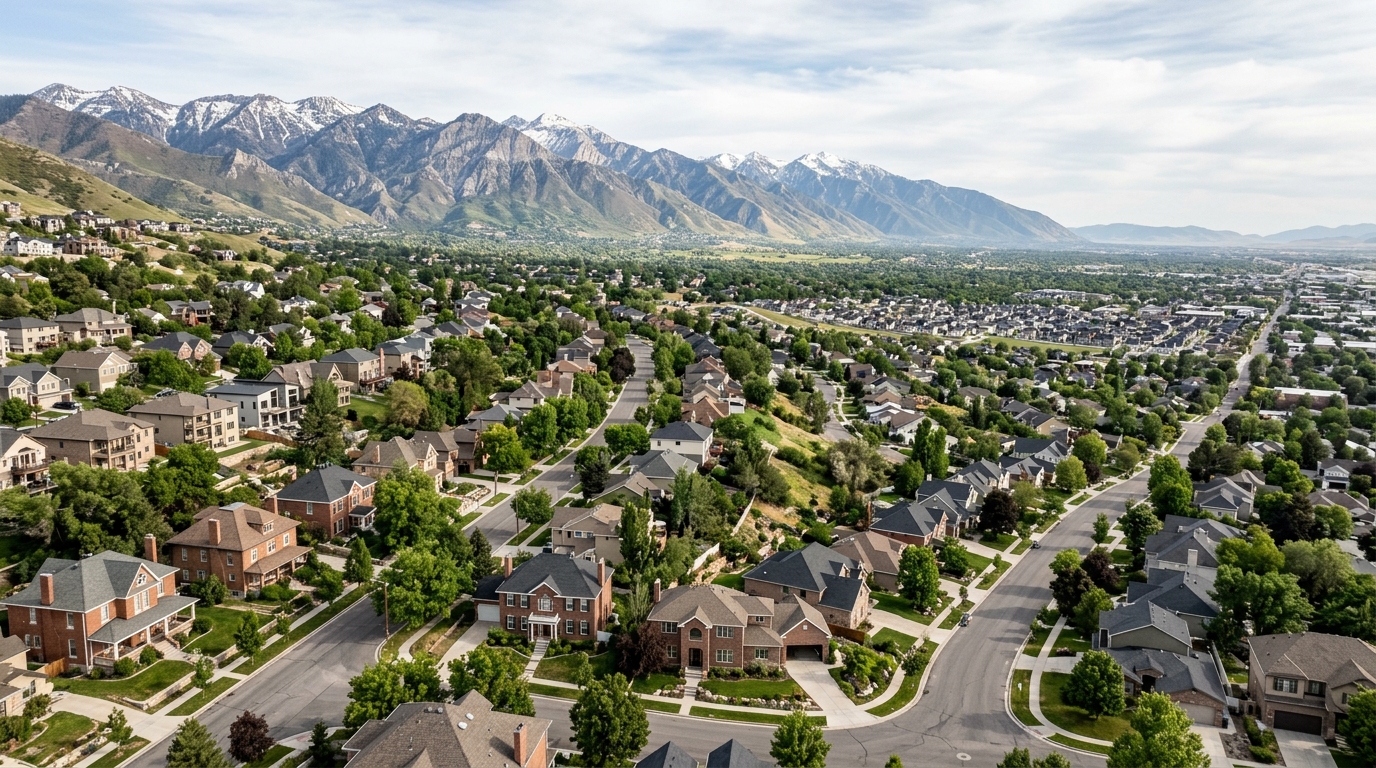
The single most useful thing to know about relocating to Salt Lake City without firsthand area knowledge is that there is no single "Salt Lake City market." Prices swing from $1.5 million in the 84004 Alpine zip to under $400,000 in others (the Salt Lake Board of Realtors Q2 2026 data, so a citywide median tells you almost nothing about the specific street you'd actually live on). That geographic spread is the exact reason distance is a real risk, and the exact reason a local agent and validated zip-level data matter more than a national portal's average. The market is also fast: homes across the city have generally been going under contract in roughly a month, and the most competitive listings move in about a week. For most remote buyers, that means either renting briefly to learn the valley firsthand, or buying near arrival with a target neighborhood already vetted against price, commute, and air-quality data before you land.
How much do home prices actually differ between Salt Lake City zip codes?
Salt Lake County set a housing record in the second quarter of 2026, with a typical single-family home costing $645,000, the highest for Utah's most populous county since Q2 2022, according to the Salt Lake Board of Realtors. That county figure hides enormous variation. The same Q2 2026 report put the 84004 Alpine zip at a $1,545,000 median single-family price while the 84006 Copperton zip sat at $380,000. A remote buyer working from one "city median" cannot see that a four-times price gap exists between zips inside the same county.
Inside Salt Lake City proper, the neighborhoods matter as much as the numbers. Federal Heights and the upper Avenues sit close to the University of Utah and tend to carry a premium for their hillside views and older architecture. Yalecrest, near the 1300 East corridor, is prized for its brick period homes and tree canopy. Sugar House offers a walkable urban core with newer condos and older bungalows side by side. Holladay and Cottonwood Heights push southeast toward the canyons, trading some commute time for larger lots and quicker ski access. Each of these carries a different price floor, and none of them behaves like the citywide average.
This is why buying an unfamiliar area sight-partly-unseen is the core hazard of relocating. The fix is concrete: map your budget and commute node against zip-level price data before you shortlist, rather than after. If you want a starting framework, our Utah relocation buyer guide and overview of Salt Lake City neighborhoods break the areas down by tradeoff rather than by marketing.
Should you rent first or buy right away when relocating to Salt Lake City?
Rent first if your job or commute is unsettled, if you have never experienced a valley inversion winter, or if you want to observe several neighborhoods across seasons before committing capital. Buy on arrival if your employment is confirmed, your target area is already validated against zip-level price and hazard data, and you accept a fast, low-inventory market where hesitation costs you listings.
Both paths are viable. Roughly 1,055 rental properties were available across the city with a median monthly rent near $1,750, per June 2026 market commentary, so renting to learn the valley is realistic. But waiting has a measurable cost, because prices are still rising modestly. The tradeoffs line up cleanly:
| Decision factor | Rent first, then buy | Buy on relocation |
|---|---|---|
| Area knowledge | Time to learn zip-level spreads, from $1.5M Alpine to sub-$400K zips (Salt Lake Board of Realtors, Q2 2026) | Relies on agent plus data to select the area before arrival |
| Market timing | Avoids bidding under pressure; homes have been going pending in roughly a month | Locks today's price in a market where hot homes go pending in about 7 days (Redfin, June 2026) |
| Upfront cash | Rent plus deposit near $1,750/month | Down payment and closing on a $585K to $645K asset |
| Winter livability | Experience an inversion season before committing | May buy before seeing how air quality affects your chosen area |
The honest read: if your area knowledge is thin, renting a few months de-risks the single most expensive mistake, which is buying in the wrong neighborhood under time pressure. If your job is locked and your area is vetted, buying avoids paying rising prices twice.
How fast does the Salt Lake City market move for a remote buyer?
Salt Lake City is a competitive, seller-favored market, and that pace directly shapes how a remote purchase has to work. Many homes draw multiple offers, some with waived contingencies.
The structural driver behind that speed is scarcity. A June 2026 brokerage report counted 335 single-family homes on the market against 220 sales, which works out to about 1.5 months of inventory, well below the four to five months that signal a balanced market. When supply is that thin, a relocating buyer may have only a handful of genuine candidates in their price band at any given moment.
For someone buying from a distance, this pace cuts two ways. It penalizes indefinite renting, because prices keep drifting up while you wait. But it also punishes rushing into an unfamiliar area, because a fast market gives you little time to reconsider once you write. The practical answer is to do the slow work early: get pre-underwritten, build your neighborhood shortlist before you list-shop, and use video tours and a local agent's eyes to move quickly on the right listing rather than any listing. Our guide to remote video tours and shortlist verification covers how to compress that process without buying blind.
What do taxes, cost of living, and winter air quality cost you here?
Utah's tax structure is comparatively light for homeowners. The state has a flat 4.45% income tax and a 0.48% effective property tax rate on owner-occupied housing value (the Tax Foundation's 2026 index). On a $585,000 primary residence at that 0.48% rate, the illustrative annual property tax lands around $2,808, though actual bills blend 26 overlapping taxing districts, so your parcel's number will differ.
Utah also gives primary residences a structural discount. The Utah Constitution assesses a primary residence at 55% of fair market value, which is why owner-occupied property tax runs low. That discount is not automatic on every property transfer, so a buyer should confirm the residential exemption is filed at closing rather than assume it carried over.
On day-to-day spending, the cost of living in Salt Lake City runs about 5% above the national average, with housing about 20% higher and utilities about 15% lower, per Redfin's 2026 cost-of-living data. Retail sales carry an 8.45% sales and use tax in the city, with an added 1% restaurant tax on prepared food.
Then there is the valley's winter air. An inversion is a meteorological condition that traps pollutants in the valley basin during cold months. Winter PM2.5 can run more than five times summer concentrations, and on January 13, 2026, Salt Lake City ranked worst in the nation with an AQI of 123, per IQAir. The annual average is still comparatively good at 6.3 µg/m³ for 2024, so the issue is seasonal, not constant. It matters most for where you buy, because higher-elevation benches like Federal Heights and Cottonwood Heights often sit above the worst of the inversion layer, while valley-floor addresses feel it hardest. If anyone in your household has respiratory sensitivity, this is a factor to weigh before you commit to an elevation. Our cost-of-living breakdown goes deeper on the recurring numbers.
What should you verify before committing to a purchase from a distance?
Before you write an offer on a home you have not stood inside, confirm three categories in order: your employment, your neighborhood fit, and your closing details. Employment first, because the metro's job picture is nuanced. Salt Lake City, Murray posted one of the larger over-the-year employment gains among metros at 2.1%, per the BLS May 2026 metro release, yet a separate ADP Research study reported in May 2026 found the metro ranked last among major metros for recent college graduates, citing weaker entry-level hiring and below-median wages. Confirm your specific offer and start date before you commit purchase capital.
Second, validate the neighborhood against real data, not a listing photo. Check the zip-level median for your target area against the Salt Lake Board of Realtors figures, test your actual commute on TRAX or FrontRunner, and account for elevation and inversion exposure. The TRAX light rail runs seven days a week at roughly 15-minute peak intervals, while FrontRunner commuter rail runs about every 30 minutes at peak with no Sunday service, so transit-oriented buyers should pre-select near a rail node rather than assume coverage.
Third, verify the closing mechanics. Confirm the residential exemption filing so you get the 55%-of-value assessment on your primary home, get a full inspection even in a fast market, and understand which of the 26 taxing districts your parcel falls into. If you are moving from out of state, our guides on relocating to Utah from another state and moving from California to Utah cover the paperwork differences that catch people off guard. Interest from the West Coast is strong right now: Los Angeles homebuyers searched to move into Salt Lake City more than any other metro in early 2026, followed by Seattle and Washington, D.C., per Redfin migration data.
Frequently Asked Questions
Is it better to rent first or buy immediately when relocating to Salt Lake City?
Renting for six to twelve months before buying gives you time to experience different neighborhoods across seasons, commute patterns, and proximity to daily needs before committing to a purchase. That said, if the timing aligns with your finances and you have reliable local guidance on neighborhood trade-offs, buying immediately is not off the table. The real risk of buying too quickly is locking into an area that turns out to be a poor fit for your lifestyle, which is harder to undo than a lease.
How competitive is the Salt Lake City housing market for buyers?
Salt Lake City has historically drawn strong demand relative to housing supply, which means well-priced homes in desirable areas can move quickly and sometimes attract multiple offers. Buyers relocating from out of state are at a disadvantage if they are not pre-approved and working with someone who knows current inventory conditions. Competition tends to vary by price point and neighborhood, so the experience in one part of the city can differ noticeably from another.
What is the property tax and income tax situation in Utah?
Utah has a flat state income tax rate, and property taxes in Salt Lake City are generally considered moderate compared to many other western metros. Property tax is calculated based on the assessed value of your home, and primary residences qualify for the primary residential exemption, which reduces the taxable portion of the home's value. These figures can shift with reassessments and legislative changes, so reviewing the Salt Lake County Assessor's current rates is worth doing before you close.
How much does it cost to live in Salt Lake City compared to the national average?
Salt Lake City sits above the national average in housing costs, which has been driven by population growth and limited land availability between the Wasatch Mountains and the Great Salt Lake. Groceries, utilities, and transportation tend to fall closer to or slightly above the national median. The overall picture depends heavily on where in the city you live and whether you are renting or owning, so cost of living should be evaluated at the neighborhood level, not just citywide.
How does Salt Lake City winter air quality affect where I should live?
Salt Lake City sits in a valley that traps cold air and pollution during winter temperature inversions, and air quality during these periods can reach unhealthy levels. Elevation matters: neighborhoods higher on the benches of the Wasatch Front tend to sit above the inversion layer and experience noticeably cleaner air during these episodes. If air quality is a health concern for you or your family, factoring elevation into your neighborhood search is a practical and meaningful consideration, not a minor one.