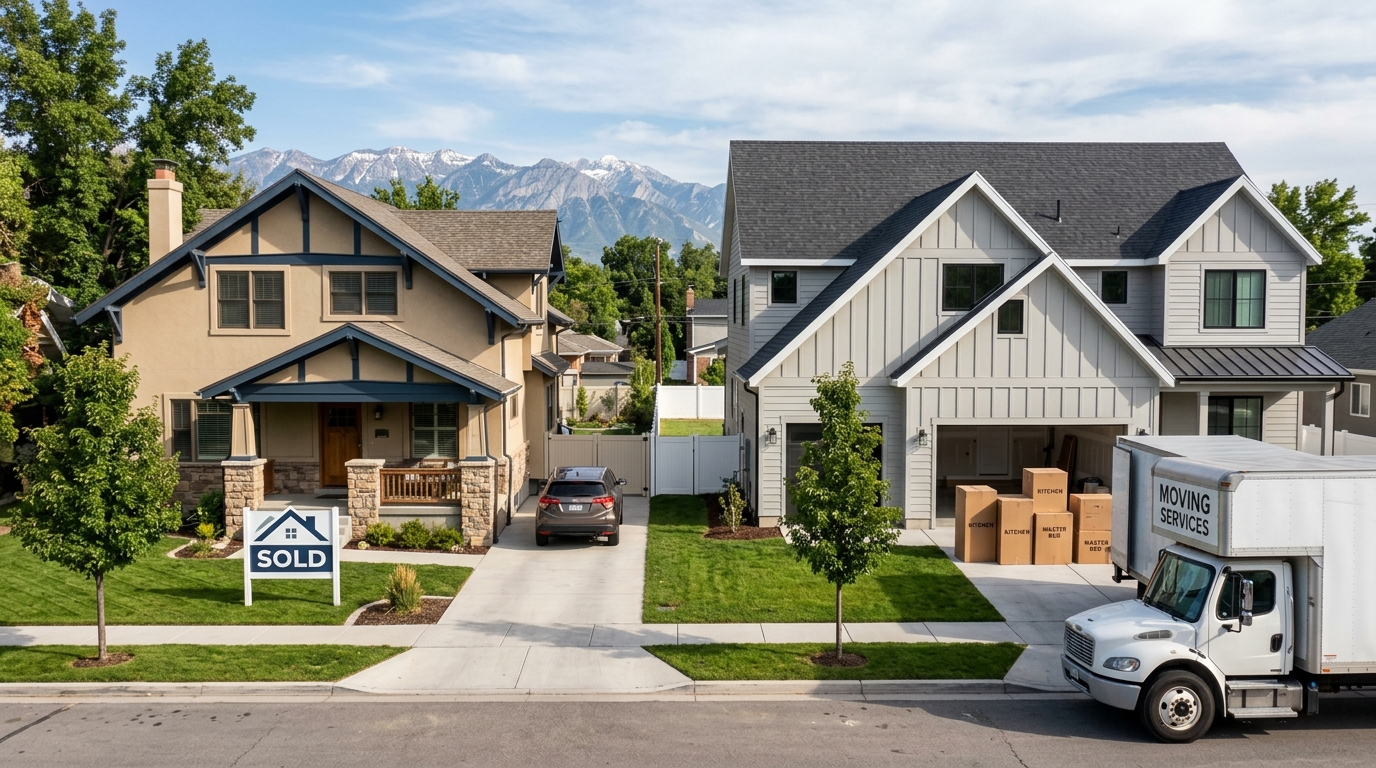
Moving up while selling another home near Salt Lake City comes down to one decision: how to sequence and finance two transactions that rarely close on the same day. In a seller-favorable market where single-family homes hit a $685,000 median in June 2026 with only 1.5 months of inventory, per the Wasatch Front Regional MLS via Joel Carson, buyers who can close without waiting on a home sale carry a real advantage. (Salt Lake City, UT Market Trends - Movoto) Your practical choices are financing the gap with a bridge loan or a HELOC so you can make a non-contingent offer, attaching a home-sale contingency and accepting a weaker negotiating position, or selling first and arranging a rent-back. The right path depends on your equity, your timeline pressure, and how quickly your current home will sell. Two Utah-specific items also shape the math: the property-tax exemption you can only claim on one home, and the earnest-money deadlines written into your purchase contract.
Should I sell my current home first or buy the move-up home first?
The sequencing question turns on whether you can afford, even briefly, to carry two housing payments. Selling first eliminates that risk and hands you a clean, cash-backed offer, but it can leave you scrambling for a place to live if your next purchase lags. Buying first lets you move once and avoid interim housing, but it exposes you to overlapping mortgages, insurance, and taxes until your old home sells.
In today's Salt Lake City market, sellers hold the leverage. With inventory at 1.5 months, well below the four to five months that signal a balanced market according to Wasatch Front Regional MLS data from June 2026, a buyer who has to sell first competes poorly against buyers who can close cleanly. That reality pushes many move-up owners in neighborhoods like Sugar House, Holladay, and the Avenues toward buying first with gap financing, then listing their current home right after going under contract.
The counterweight is carrying cost. Even a short overlap can run into thousands of dollars across two mortgages, two insurance policies, two tax bills, and two sets of utilities. If your equity is thin or your income can't comfortably support two payments for a couple of months, selling first is the safer play.
You can read a fuller breakdown of buying a home before selling yours in Utah and the reverse case of selling before buying in Utah to weigh which order fits your situation.
How does a bridge loan differ from a HELOC when moving up in Utah?
A bridge loan is short-term financing, 12 months or less per the Consumer Financial Protection Bureau, secured by the equity in your current home and purpose-built to cover the down payment and closing costs on your next one until your old home sells. A HELOC, by contrast, is a revolving line of credit secured by your home that you can borrow, repay, and borrow again during the draw period. Both can fund a non-contingent offer; they solve the same problem in different ways.
The single biggest practical difference is timing. A HELOC can take time to approve and set up, so it works only if you open it before you list or go under contract. Once your home is listed or under agreement, most lenders won't originate a new line against it. A bridge loan, offered by specialized lenders, can close faster and is designed for urgent purchase timelines, which suits the compressed schedules common when homes go pending in around 12 days, as Zillow reported for Salt Lake City as of June 30, 2026.
| Factor | Bridge loan | HELOC on current home |
|---|---|---|
| What it is | Short-term lump-sum loan, 12 months or less (CFPB) | Revolving credit line you draw as needed |
| Typical pricing | Often prime rate plus 2% (Rocket Mortgage) | Usually lower rates and costs (The Mortgage Reports) |
| Best timing | Can close fast when the sale is urgent | Must be opened before listing |
| Main downside | Three payments if the old home doesn't sell | Variable rate that can fluctuate |
Bridge loans are typically interest-only until your home sells, and lenders often lend up to 80% of your current home's combined loan-to-value. On a $400,000 home with $200,000 owed, that math leaves roughly $120,000 available for your next down payment and closing costs, using HomeLight's example formula. the practical trade-off is cost and clock: if your old home lingers, you could end up carrying your original mortgage, your new mortgage, and the bridge loan all at once.
The cost of the new, larger mortgage matters too. The 30-year fixed averaged 6.58% as of July 23, 2026 (Freddie Mac's Primary Mortgage Market Survey, its highest level since August 2025, while the 15-year averaged 5.96%). Run both financing paths against a real Loan Estimate before choosing; the Utah mortgage and financing guide walks through what to compare.
Will a home-sale contingency hurt my offer in a seller-favorable Salt Lake City market?
Yes, in most cases. A home-sale contingency, written in Utah as the "Subject to Sale of Buyer's Property Addendum" to the Real Estate Purchase Contract, lets you back out without penalty if your current home doesn't sell within an agreed window. It removes the need for interim financing, which is the appeal. The cost is negotiating power.
When a seller receives two offers and one requires the buyer to sell first, sellers often choose the cleaner offer because they can't predict whether that other closing takes a few weeks or several months. In Utah, brokers describe this contingency as less common in seller-favorable markets, and Salt Lake City is firmly seller-favorable right now. Home-sale contingencies can also stretch the contingent phase to 60 to 90 days or more, which few sellers accept when homes are moving quickly.
There's genuine fall-through risk on the other side, too. Roughly 4% to 7% of contingent offers collapse (the National Association of REALTORS). A contingency that a seller does accept still carries the chance the whole deal unwinds.
If you're competing for a home in Yalecrest, Federal Heights, or Cottonwood Heights, gap financing that lets you write a non-contingent offer usually beats a contingency. The exception is a home that has sat on the market or a soft micro-segment where a seller values certainty of a qualified buyer over speed. To see how offer terms stack up, review what makes a strong offer in Utah.
What happens to my property-tax exemption and capital-gains bill if I own two Utah homes at once?
You can claim Utah's primary-residential exemption on only one home, so during any overlap the second home is taxed on its full value. Under Article XIII, Section 3 of the Utah Constitution, county assessors exempt 45% of the fair market value of a primary residence plus up to one acre, as the Utah State Tax Commission explains. Only one exemption is allowed per household statewide.
The dollar effect is significant. On a $500,000 home, only $275,000 is taxable as a primary residence, but the full $500,000 is taxable as a second home, so the same house owes roughly 1.8 times as much tax during the overlap. Utah does allow a part-year exemption if a property serves as a primary residence for 183 or more consecutive days in the calendar year, which can matter depending on when each closing lands.
Your combined property-tax rate depends on your specific taxing district, which is set annually through Utah's truth-in-taxation process and varies within a county. Confirm your exact parcel rate with the Salt Lake County Assessor before you budget the overlap.
On the sale side, the federal capital-gains exclusion is the item to plan around. Under IRS Topic No. 701, you can exclude up to $250,000 of gain on the sale of a main home, or up to $500,000 on a joint return, provided you owned and used it as your main home for at least two of the five years before the sale. If your current home has appreciated substantially, confirm you meet the two-year test before selling, because timing a sale a few months early can turn tax-free gain into a taxable one.
What should I confirm with my lender, CPA, and signed documents before moving up?
Confirm the numbers that only you and your professionals can supply: your current home's value, mortgage balance, available equity, credit score, income, and target move-up price. These figures determine whether you qualify for a bridge loan or HELOC at all. Bridge and HELOC lenders typically want substantial equity, often at least 20% to 30%, plus verified income, so get written quotes rather than relying on rough ranges.
Ask your CPA two questions specifically: whether you clear the two-year ownership-and-use test for the IRS §121 exclusion, and how the loss of the primary-residential exemption on your second Utah home affects your overlap budget. These interact with your filing status, which changes the exclusion cap between $250,000 and $500,000.
On the contract side, the Utah REPC's deadlines govern your earnest money. The Due Diligence period, written into Section 24(a) and typically 14 calendar days, is your window to inspect, review disclosures, and cancel in writing for a full earnest-money refund. Miss that deadline without a valid contingency and canceling generally means forfeiting your earnest money. Any extension must be in writing on UAR Form 8, signed by both parties; a verbal agreement to extend is not enforceable under Utah law.
Because over 61% of mortgage holders carry rates below 4%, per the Salt Lake Board of REALTORS 2026 Housing Forecast, many move-up owners are trading a low rate for a higher one on a larger loan. Model that new payment before committing. For a full walk-through, see how to sell a home in Utah and how to buy a home in Utah.
Frequently Asked Questions
Is it better to sell my current home before buying a move-up home in Salt Lake City?
Selling first puts you in a stronger negotiating position as a buyer because you arrive without a home-sale contingency and with clear proceeds in hand. the practical trade-off is the gap period, you may need temporary housing between closing dates, which adds cost and friction. If Salt Lake City inventory in your target price range is moving quickly, that gap can be short, but it is rarely zero. Whether the cleaner offer position outweighs the inconvenience depends on how competitive your target price band is at the time you are ready to move.
What is the difference between a bridge loan and a HELOC for a Utah move-up buyer?
A bridge loan is a short-term loan secured against your departing home that is specifically designed to carry you through the overlap between buying and selling, it typically matures within six to twelve months and is repaid when your current home closes. A HELOC is a revolving line of credit also secured by your existing home's equity, but it requires that home to be free of a pending sale lien and lenders often freeze or reduce it once a sale is in progress. For a Utah move-up buyer, the practical distinction is timing: a bridge loan is purpose-built for the transaction overlap, while a HELOC works better when you have flexibility to tap equity before listing.
Does a home-sale contingency weaken my offer in Salt Lake City?
Yes, in most cases it does. A home-sale contingency tells the seller that your purchase depends on a separate transaction closing, which introduces a variable outside their control. Sellers in active Salt Lake City price ranges will generally prefer an offer without that condition when they have alternatives. That said, a contingency is not automatically disqualifying, a strong price, solid earnest money, and a well-priced departing home can offset some of the perceived risk, particularly if the market slows and sellers have fewer competing offers.
Can I keep the Utah primary-residential exemption on two homes at once?
No. Utah's primary residential property tax abatement is tied to one property per household, the home where you actually reside and claim as your primary residence. Once you close on a move-up home and establish it as your primary residence, the departing property no longer qualifies for that exemption status. Timing matters: if you own both properties simultaneously, only one will carry the primary residential designation for that tax year, so you should confirm the transition with the Salt Lake County Assessor's office to ensure the exemption is applied correctly to the right parcel.
What happens to my earnest money if my current home doesn't sell before a Utah REPC deadline?
Under the Utah Real Estate Purchase Contract, if you have a properly written home-sale contingency with a defined resolution deadline and your current home does not sell by that date, you can exercise the contingency to cancel the contract and recover your earnest money, provided you follow the notice procedures outlined in the REPC. If you miss that deadline without acting, you may lose the contingency protection and your earnest money could be at risk. The exact mechanics depend on how the contingency addendum is drafted, so the language your agent uses when writing the offer is the controlling factor, not a general rule.