Park City Luxury

Deer Valley Ski-In/Ski-Out Homes: What Buyers Should Know in 2026

By Kamee Shrope · Global Real Estate Advisor, Engel & Völkers Salt Lake City · May 27, 2026 · 11 min read

All Articles

What does true ski-in/ski-out mean in Deer Valley, and what should buyers know in 2026?

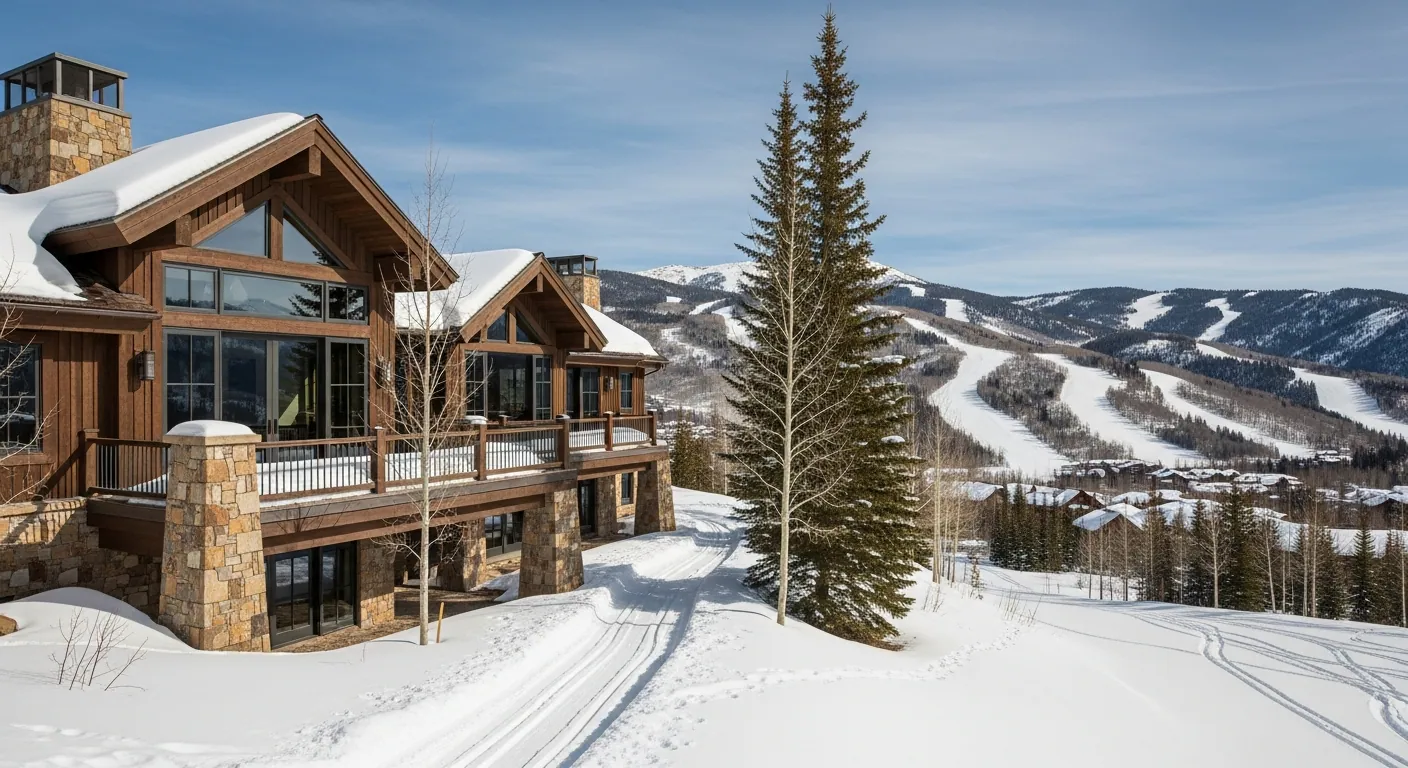
True ski-in/ski-out in Deer Valley means clicking into your bindings at the door of your residence, gliding to a chairlift without removing your skis, and returning the same way — no shuttle, no boot-walk, no parking deck. Few properties meet that standard. Most listings marketed as ski-in/ski-out are either ski-out only, ski-valet adjacent, or within a short walk of a base lift. The 2026 buyer should understand the distinction before touring, because it drives a price gap that can exceed eight figures between two units in the same village. The Deer Valley East Village expansion, now opening in phases off the old Mayflower Mountain Resort footprint, is also reshaping what new slope-side inventory looks like and how older Empire Pass and Silver Lake product is repriced against it.

What "ski-in/ski-out" actually means in Deer Valley

The phrase gets used three different ways in Park City listings.

True slope-side access. Skis stay on. The residence fronts a groomed run or sits beside a private ski way feeding a lift. Empire Pass estates on Red Cloud and Solamere, plus a small number of Silver Lake and Snow Park units, qualify — as do a limited number of fractional residences inside the Stein Eriksen Residences, Goldener Hirsch Residences, and The Chateaux at Silver Lake.

Close-but-shuttle. Most "ski-in/ski-out" condo developments deliver this product. A ski valet stores your gear at a base building and shuttles you to the lift line. It's comfortable and often nearly indistinguishable from true slope-side in practice — but it's not the same asset, and resale pricing reflects the gap.

Walking-distance-to-base. Some listings use "ski-in/ski-out" to mean five to ten minutes' walk of a chairlift. In Snow Park and at the edges of Silver Lake, walking-distance product is common. Paying a true slope-side premium for what is functionally a walk-up condo is one of the most common pricing mistakes in this market.

A practical test: if the listing leans heavily on "ski valet," the residence is most likely close-but-shuttle. The valet exists because the skis can't stay on from the front door.

The four ski-in/ski-out zones in Deer Valley

Deer Valley's slope-side real estate sits in four named zones. Each has its own elevation, architecture vocabulary, and price band.

Snow Park

Snow Park is the base village — the lower-elevation entry point off Deer Valley Drive and the location of Snow Park Lodge. It's the most accessible of the four zones, with the easiest car drop-off, the shortest drive from Salt Lake City International, and the broadest mix of product types. Condos run smaller and more affordable than Silver Lake or Empire Pass equivalents. True slope-side inventory exists but is limited; most Snow Park "ski-in/ski-out" condos are walking-distance-to-base. Snow Park is often where first-time Deer Valley buyers land before trading up the mountain.

Silver Lake Village

Silver Lake is the mid-mountain village, accessed via Royal Street, and home to the trio buyers tend to think of as the "luxury triangle" of slope-side hotels with deeded residences: Stein Eriksen Lodge, The Chateaux at Silver Lake, and Goldener Hirsch Residences. Silver Lake delivers a walkable European-style village with dining, ski services, and the central lift network. True slope-side condos do exist here, especially within the named lodges. Resale pricing reflects scarcity — Silver Lake is the most-asked-about zone for buyers who want a single-key, full-service lifestyle without managing a free-standing home.

Empire Pass

Empire Pass is the upper-mountain neighborhood — the highest-elevation ski-in/ski-out zone in Deer Valley. Subdivisions inside Empire Pass include Solamere, Red Cloud, and the Talisker-developed estate sites. Empire Pass is where Deer Valley's free-standing trophy homes live: large single-family estates with private ski access, panoramic views, and price tags that routinely run into eight figures. Condo and townhome product exists here too, often inside developments that include club membership at the Talisker Club. Empire Pass is also the most car-dependent of the four zones — getting off-mountain to Park City Main Street is a real drive.

Deer Valley East Village (the expansion)

Deer Valley East Village is the new product. Built on the old Mayflower Mountain Resort footprint, the East Village is being delivered in phases and adds roughly 3,700 acres of expanded terrain when fully operational — close to doubling Deer Valley's lift-served skiing. The East Village sits in Wasatch County, not Summit County, which affects taxation and short-term rental rules. New product here is being delivered as branded residences, condos, and a small number of estate sites. Buyers attracted to East Village are typically choosing new construction, lower historical HOA structures, and the upside of being early in a developing village — at the cost of the mature, walkable amenity base that Silver Lake delivers today.

The 2026 expansion — what's open, what's coming

Deer Valley's expansion into the East Village is the biggest story shaping the resort's real estate market right now. The expansion more than doubles Deer Valley's skiable terrain across phases — Deer Valley's original ~2,000 acres plus roughly 3,700 East Village acres totals over 5,700 acres at full build-out, with new lifts, two interconnected base areas, and a much larger overall trail map. A soft opening with limited East Village terrain ran during the 2024-2025 season, with the main expansion (around 2,900 acres and 9 lifts) opening for the 2025-2026 season; later infrastructure is scheduled in subsequent seasons.

The effect on existing inventory is twofold. The broader trail map increases the value of upper-mountain Empire Pass properties that now sit on what is effectively a much larger resort. And brand-new East Village product is creating direct competition for older Silver Lake and Snow Park condos — buyers comparing a 1995-build Silver Lake unit against a 2025 East Village residence with current finishes and lower historical HOA assessments are running spreadsheet comparisons that older inventory has not historically had to defend against.

The honest 2026 answer to "Should I wait for East Village or buy existing inventory?" is that it depends on whether mature village amenities or brand-new construction matters more to the way you'll actually use the home.

Property types — what you can actually buy

Three structural choices dominate Deer Valley ski-in/ski-out purchases.

Single-family estates. Almost exclusively an Empire Pass product, with a small number in East Village. Free-standing homes on private lots with deeded ski access. Total control of the asset, full privacy, and the largest footprints — but also full responsibility for maintenance, staffing, and snow management.

Slope-side condos. Found in all four zones. Condos inside the Silver Lake luxury triangle (Stein Eriksen, Chateaux, Goldener Hirsch) and in Empire Pass developments deliver hotel-grade service — ski valet, concierge, housekeeping, restaurants — with the deeded ownership of a residence. The trade is meaningful HOA exposure and shared common spaces.

Fractional and branded residences. Stein Eriksen Residences, Goldener Hirsch Residences, and a small number of other branded products offer fractional ownership — typically four to twelve weeks of deeded use per year. Fractionals trade at a fraction of full-ownership price and shift carrying costs to the developer's program. Resale liquidity is thinner than full-ownership inventory, which is the most common surprise for first-time fractional buyers.

Pricing reality 2026

Pricing in Deer Valley moves quickly and varies by zone, view, and finish. As of late-2025 to mid-2026 market data, the following bands frame what buyers should expect. These ranges should be verified against current Park City MLS and Summit County recorder data at the time of any actual offer.

  • Entry-level true slope-side condos: roughly $3-5M for smaller two-bedroom units in older Silver Lake or Snow Park buildings.
  • Mid-tier slope-side condos (three- to four-bedroom in named luxury triangle properties): roughly $6-15M, depending on view, floor, and recent renovation.
  • Empire Pass estates: commonly $15-40M. The high end of this band tracks new construction with full lot, ski-out access, and club membership.
  • Ultra-trophy estates (the few true ski-on/ski-off mansions with private access and exceptional view corridors): above $50M, with the upper end of the market crossing into nine figures on rare occasions.
  • East Village new construction: pricing is still establishing. Early phases have priced competitively against equivalent Silver Lake product, with the upside narrative attached to phase build-out.

Two pricing notes worth flagging. First, Deer Valley pricing is sticky on the way up and slow to adjust on the way down — sellers anchor on neighbor comps for long stretches. Second, view premiums in Empire Pass are real and quantifiable. A home with an unobstructed eastern view across the Jordanelle can command meaningfully more than the same floor plan looking the other direction.

HOA and carrying-cost reality

Deer Valley HOAs are not modest, and underestimating the carrying cost is one of the most common post-close regrets. In the named luxury triangle properties and fully serviced Empire Pass developments, annual HOA dues commonly run $25,000 to $50,000 or more, with the highest-service properties exceeding that. Estate-level homes often carry separate club dues on top of property-level assessments.

What buyers are actually paying for varies, but a fully serviced Deer Valley HOA typically covers:

  • Snow removal — including private driveways and ski ways
  • Ski valet — gear storage, warming, transport to and from the lift
  • Concierge — restaurant reservations, lift tickets, transportation booking
  • Year-round groundskeeping and exterior maintenance
  • Insurance for common areas and shared structures
  • Property management and front-desk staffing in branded buildings

What HOAs typically do not cover:

  • Property taxes
  • Interior maintenance and capital improvements
  • Utilities for the residence
  • Personal property insurance
  • Club initiation fees and dues (often separate)

The honest framing for buyers: the HOA fee is not a luxury — it is the cost of the asset being usable as a slope-side residence. Eliminating that service layer would mean managing snow, staff, and access yourself, which is rarely what Deer Valley buyers want.

The IKON Pass conversation

Deer Valley has been on the IKON Pass since the pass launched for the 2018-2019 season (Alterra Mountain Company acquired Deer Valley in 2017 and Deer Valley was an IKON partner from day one). For owners, that has two practical effects.

First, an IKON Pass — either full or base — grants access at peer resorts under that pass's structure. Owners who travel between mountains during a season find this meaningful. The IKON network includes Alta, Snowbird, Brighton, and Solitude on the Salt Lake side, plus a wide collection of Western and international resorts.

Second — and this is the part new buyers consistently misunderstand — Deer Valley still controls its own skier-day caps. Even with an IKON partnership, Deer Valley limits the number of skiers on the mountain on any given day, which is the policy that historically kept lift lines short and runs uncrowded. The IKON partnership did not erase that. Day-pass purchases and IKON redemptions are both metered against those caps.

The practical takeaway: IKON membership at Deer Valley is a feature, not a crowding problem.

The no-snowboarders rule

Deer Valley does not permit snowboarders. It is one of only three U.S. ski resorts that maintains this policy — Alta and Mad River Glen are the others. The rule is enforced at the lift, has been in place since the resort opened, and is not changing in any timeline currently public.

For real estate buyers, the rule matters in one specific scenario: family decisions where one family member snowboards. A snowboarding teenager or spouse can ski Park City Mountain Resort, which is a short drive away and is also an IKON partner — but they will not ride at Deer Valley. Multi-generational buyers who want a single resort that accommodates the whole family sometimes choose Park City Mountain Resort-adjacent inventory (The Colony at White Pine Canyon, for example, is technically on the Park City Mountain side, not Deer Valley) for this reason.

Short-term rental considerations

Short-term rental rules in the Deer Valley footprint are not uniform. Three layers stack.

Municipal rules. Park City Municipal and Summit County have STR licensing and zoning rules. Deer Valley East Village sits in Wasatch County, which has its own framework. Buyers planning to rent should verify which jurisdiction the property is in and what's required for licensing.

HOA rules. This is usually the binding constraint. Some Deer Valley HOAs prohibit STRs entirely. Some allow them with minimum-stay requirements (often seven nights). Some properties are sold furnished and pre-enrolled in a developer-run rental program — branded products like Stein Eriksen Residences, for example.

Utah TRT (transient room tax). Properties operated as short-term rentals are subject to Utah's transient room tax, plus county and municipal add-ons. Owners are responsible for collection and remittance unless a rental program handles it.

Buying a Deer Valley property with rental income in mind is a strategy that works in some buildings and fails in others. The diligence question — "Does this HOA allow STRs, and what are the restrictions?" — should be asked before offer, not at closing.

The Deer Valley ski-in/ski-out buyer profile

Three patterns dominate the buyer pool.

Multi-generational family compound. A family wants a single home that accommodates parents, adult children, and grandchildren across two or three weeks a season. These buyers usually land in Empire Pass estates or large Silver Lake residences, prioritizing bedroom count and gathering spaces.

Primary-residence relocators. Buyers moving to Park City full-time, often from California, Texas, Florida, or the Northeast. They prioritize year-round livability — summer hiking and biking, fall weather, school access. Snow Park and Silver Lake see this buyer most often; Empire Pass less so because of the winter drive logistics.

Lifestyle-driven second-home buyers. Buyers who want six to ten weeks of use, mostly winter, with the rest covered by a property manager. Fractional and branded residences fit this buyer well; full-ownership condos in serviced buildings also work.

What surprises new Deer Valley buyers most often is how much the "shape" of the year matters. A winter-trophy property feels different in mud season than during the December-through-March experience that sold them.

Frequently asked questions

What's the cheapest ski-in/ski-out condo in Deer Valley?

Entry-level true slope-side condos in Deer Valley as of 2026 run from roughly $3M for smaller, older units in Snow Park or Silver Lake. Below that band, listings are usually walking-distance-to-base rather than true slope-side. Pricing should be verified against current MLS data.

Can I snowboard at Deer Valley?

No. Deer Valley does not allow snowboarders. The closest snowboard-friendly resort is Park City Mountain Resort, which is a short drive away and is on the same IKON Pass.

Does Deer Valley take the IKON Pass?

Yes. Deer Valley has been on the IKON Pass since the pass launched for the 2018-2019 season (Alterra Mountain Company acquired Deer Valley in 2017 and Deer Valley was an IKON partner from day one). The IKON Pass provides access alongside Deer Valley's own pass products, subject to the resort's daily skier-day caps.

What does an Empire Pass home actually cost?

Empire Pass estates commonly trade in the $15-40M range. Trophy properties with private ski access and exceptional view corridors can exceed $50M. Condo and townhome inventory inside Empire Pass developments is available at lower price points.

Are Deer Valley HOAs high?

Yes, by most market comparisons. Fully serviced HOAs in named luxury triangle properties and high-end Empire Pass developments commonly run $25,000-$50,000 annually, with some higher. The fee covers snow removal, ski valet, concierge, and year-round property services that make the residence usable as a slope-side asset.

What's the difference between Snow Park and Silver Lake?

Snow Park is the base village at lower elevation, with easier access and broader product mix. Silver Lake is mid-mountain, smaller, more European-village in feel, and home to the Stein Eriksen Lodge, Goldener Hirsch Residences, and The Chateaux. Silver Lake pricing per square foot is generally higher than Snow Park for comparable product.

Should I wait for East Village or buy existing Deer Valley inventory?

The honest answer is that it depends on whether mature village amenities matter more to you than brand-new construction and the upside narrative of being early in a developing village. East Village is delivering product through 2026 and beyond; existing Silver Lake and Empire Pass inventory is a known quantity today.

Closing

Buying ski-in/ski-out in Deer Valley is a nuanced decision. The four zones each carry different assumptions about how you'll use the home, what the carrying cost will look like, and how the East Village expansion will reprice the inventory around you over the next several seasons. Buyers who slow down at the start — clarifying what "ski-in/ski-out" actually means for the way they ski, who will be using the property, and which jurisdiction the home sits in — make better decisions than buyers who chase the listing photo.

If you'd like to walk through specific Deer Valley properties privately, compare zones against your actual use case, or get current pricing on Empire Pass, Silver Lake, Snow Park, or East Village inventory, reach out through the contact page and we'll set time to talk through what makes sense for your family.

Ready to Talk?

Get in Touch with Kamee

Tell her about your goals — she'll get back to you within one business day.

Contact Me